


Functional freeze, what is it?
Maybe you came across this term in therapy, on social media, in a podcast, or from a clinician, and something about it clicked. Or maybe someone mentioned it in passing, and you thought, Wait… that sounds like me.
If you’re here, you’re likely looking for clear, grounded information about what this state actually means.
Functional freeze is the state where you’re “doing life,” but not really in it.
You’re working, parenting, showing up, but inside you feel numb, checked out, or stuck, and no amount of thinking or logic seems to pull you out of it.
In this post, I’m breaking down what this state really is, why it happens, and how your nervous system can shut down while you’re still “functioning” on the outside.
What Is Functional Freeze?
Functional freeze is a trauma- and stress-based nervous system response in which your system shifts into survival mode while you continue to function on the surface.
It’s not laziness, weakness, or “just depression.” It’s your body’s adaptive way of saying:
Instead of collapsing completely, your nervous system finds a compromise.
You can still answer emails, pay bills, and get the kids to school, but emotionally, mentally, and physically, you’re operating on low power.
You’re moving through life, but you don’t feel fully alive or connected.
So… What Causes Functional Freeze?
Functional freeze rarely appears suddenly. More often, it develops gradually as the nervous system adapts to ongoing overwhelm.
1. Trauma and unresolved overwhelm
Big “T” trauma (accidents, assaults, medical trauma, combat, sudden loss) and repeated “small t” trauma (criticism, emotional neglect, growing up in chaos) teach the body that the world isn’t safe.
When your nervous system has spent years in fight or flight, it eventually says, “I can’t keep running,” and shifts into a quieter shutdown mode just to survive.

2. Chronic stress that never lets up
Long work hours, money pressure, caregiving, relationship conflict, racism, discrimination, or living in constant performance mode slowly deplete your system.
Even if nothing looks “traumatic” on paper, your body can feel perpetually under threat. Functional freeze becomes a way to get through the day without fully burning out.
3. Highly Sensitive People (HSPs)
Highly Sensitive People process more sensory and emotional information than most. That depth is a gift but it also means:
- Noise, conflict, overstimulation, and subtle relational cues hit harder.
- What looks like “minor stress” to others can feel like a tidal wave in your system.
Over time, without tools and support, your system may default to functional freeze as a way to block out the constant intensity and “too muchness.”
4. Why this especially affects men
If you’re a man, your functional freeze might hide behind “I’m just tired,” “I’m fine,” or “I’m just not emotional.”
In reality, your system may be in survival mode, and no one, including you, has given it language.
Men are often socialized to push through, stay in control, and solve problems logically rather than emotionally. Functional freeze fits that mold perfectly, which makes it both common and invisible.
After counseling almost exclusively with men for over 10 years and running my own men’s groups, I’ve seen this pattern again and again. I’ve worked with men who were formerly incarcerated, gang‑involved, professionals, and law enforcement, and underneath the very different life stories, the same nervous‑system pattern shows up: they’re still performing, but internally shut down and disconnected.
Now that more men are embracing therapy, this matters even more. For many of them, somatic work is a must‑have, not a luxury. If we stay only in talk and insight, their behaviors often remain a mystery, even to them:
- “Why do I shut down when my partner needs me most?”
- “Why do I numb out with weed, alcohol, porn, or my phone instead of being present?”
- “Why can I handle chaos at work but feel paralyzed at home?”
Talk therapy can help make sense of history, but without involving the body and nervous system, functional freeze keeps running in the background. Somatic work gives your system a different option, so your actions can finally align with what you value, not just what your survival wiring learned.
What Happens in the Body
Think of your nervous system like a car with three main settings:
- Drive: social engagement, connection, curiosity
- Sport: fight/flight – activated and mobilized
- Power-save: freeze/shutdown
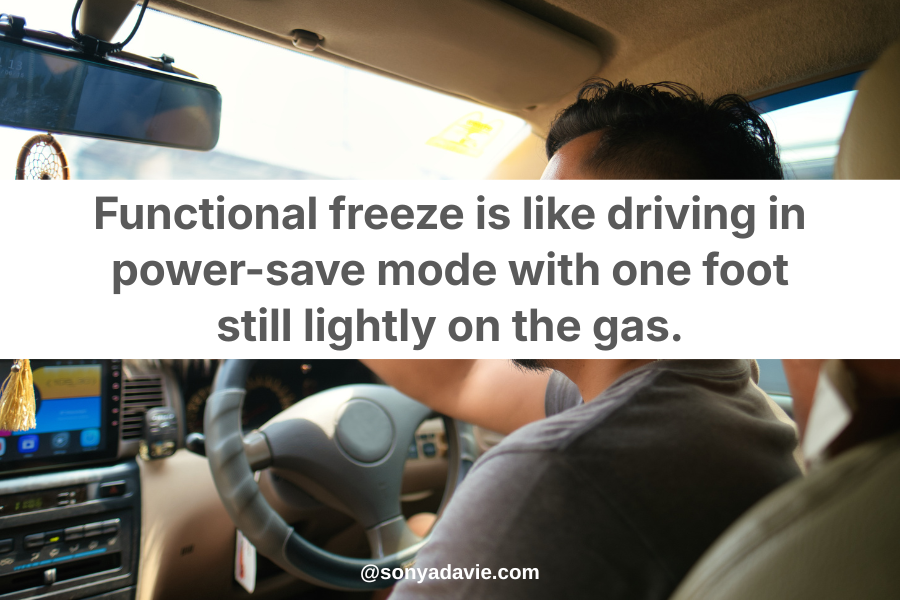
Functional freeze is like driving in power-save mode with one foot still lightly on the gas. You’re moving, but:
- Your brain: The planning, reflecting, and feeling parts go dim. You feel foggy, checked out, or disconnected.
- Your body: Energy drops. You feel heavy, tired, and sluggish often with tension underneath. Sleep doesn’t feel truly restorative.
- Your emotions: Joy and deep sadness feel muted. You might think, “I don’t care,” or “I can’t feel anything.”
- Your stress response: Threat is still sensed in the background, but instead of mobilizing, your system shuts down to avoid overwhelm.
This is why you can’t think your way out of it. The thinking brain doesn’t have full access to the controls once your body has decided,
“We’re in survival mode.”
You Can’t Think Your Way Out
This is crucial, for you and for your therapist.
When you’re in functional freeze:
- Positive affirmations and self-pep talks don’t stick.
- You might understand your stress or trauma, but your behavior doesn’t change much.
- You leave therapy saying, “That made sense,” and then go right back to numbing, avoiding, or shutting down.

It’s because the freeze state is happening in your body, not your thinking mind. Until your nervous system feels safer and more supported, your brain can’t simply “decide” to come out of it.
Functional Freeze in Daily Life: Real-World Examples
At work
You show up, attend meetings, meet deadlines but feel numb and detached.
Pain point: “I’m doing everything I’m supposed to do, and I feel nothing. I’m scared I’ll stop caring completely.”
You stare at your screen knowing you should start, but your body won’t move toward the task.
Pain point: “I know what to do, but I can’t move. I feel ashamed.”
In relationships
Your partner says, “We need to talk,” and you go silent, shut down, or say, “I don’t know,” even when you have a lot of feelings.
Pain point: “In the moment, I literally can’t speak. Later I replay it and hate myself.”
You’re physically present with your spouse or kids, but emotionally distant.
Pain point: “I love them, but I feel behind glass.”

As a man
You come home and disappear into your phone, TV, games, weed, or alcohol.
Pain point: “Everyone thinks I’m checked out or don’t care. I actually feel overwhelmed and empty, and I don’t know how to explain that without sounding weak.”
The only accessible emotions are irritation, sarcasm, or shutdown.
Pain point: “I don’t know how to be vulnerable. I either snap, make a joke, or shut down completely.”
As an HSP
You withdraw inward from overstimulation or emotional intensity.
Pain point: “It’s like my system just hits mute on everything. Other people think I’m cold or distant, but I’m actually overloaded.”
Common Numbing Patterns (and Why They’re Not the Whole Problem)
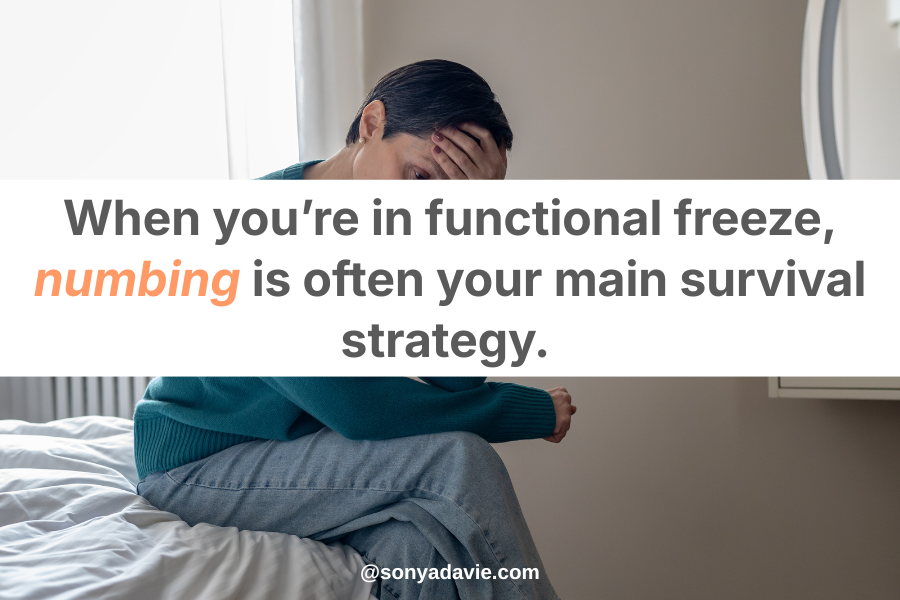
That can look like:
- Substance use: Alcohol, marijuana, pills—“I just need to take the edge off.”
- Screens: Endless scrolling, streaming, gaming to avoid feeling or thinking.
- Food: Bingeing, constant snacking, eating to soothe or zone out.
- Work or busyness: Staying constantly busy so you never have to sit with yourself.
- Porn or casual sex: Using intensity or fantasy to escape numbness or shame.
If you stop the substance or numbing behavior without replacing it with healthy, therapeutic coping skills, you’re left alone with the raw freeze state, heavy, overwhelmed, restless, and emotionally exposed.
That’s why relapse or “swapping” addictions is so common if the underlying nervous‑system state isn’t addressed.
Why This Is So Frustrating for the People Who Depend on You

From their perspective, it can look like:
You don’t care.
You’re uninterested or emotionally unavailable.
You’re procrastinating, avoiding, or “choosing” not to show up.
They may think:
“Why won’t he just talk to me?”
“She’s always on her phone and never really here.”
“I can’t rely on him—he shuts down whenever things get hard.”
Meanwhile, from your perspective:
You’re trying. You often want to engage, but feel frozen, drained, or blank. You don’t have language for what’s happening or how to change it.
Both of you are in pain, and both of you are often unaware that a functional freeze state is running the show. Without that understanding, the default is blame of yourself, your partner, or both.
Why You Need a Therapist Who Understands Somatic Work
If functional freeze lives in your nervous system and body, then therapy must include your nervous system and body.

Talk‑only therapy can help you understand your story, but if your therapist doesn’t recognize functional freeze, sessions may:
- Stay entirely in your head (insight without real change).
- Focus on “coping skills” that assume your system is willing and able to act.
- Pathologize you as resistant, unmotivated, or “not trying,” when you’re actually stuck in survival.
A therapist who understands somatic work and nervous‑system states will:
- Track your body cues: posture, breath, eye contact, muscle tension, energy shifts.
- Gently help your system find tiny bits of movement, safety, and connection instead of pushing you to “talk more” or “do more.”
- Normalize functional freeze as a protective pattern, not a character defect.
- Work slowly enough that your body doesn’t feel overwhelmed and retreat deeper into shutdown.
This is especially important for:
Men who’ve been taught to stay in their heads and avoid vulnerability.
HSPs whose nervous systems are easily overloaded.
Anyone using substances, food, or screens to cope because removing the numbing without adding regulation can backfire.
Why This Matters Even If You’re Already in Therapy
You can be in therapy, working hard, and still be stuck in functional freeze if:
- Your therapist doesn’t assess nervous‑system states.
- You only talk about thoughts and stories, not what your body is doing in the room.
- You leave sessions understanding why you are the way you are, but your day‑to‑day patterns don’t shift much.
If your therapist can’t recognize functional freeze, treatment will only scratch the surface.

If you’re reading this and thinking:
“This is me, but I never had words for it.”
“This explains my spouse/partner.”
“I’m in therapy, but we’ve never talked about my body, my nervous system, or functional freeze.”
Then you don’t need to fix everything overnight. You need a safe, structured way to start working with your nervous system instead of fighting it.
That’s exactly why I created my Stress Recovery Toolkit, a mini course designed as a beginner‑friendly entry point, even if you’re already in therapy.
If this resonated with you, this is your next step.
Functional freeze isn’t laziness. It isn’t lack of motivation. And it’s not something you “push through.”
It’s a nervous system pattern that needs understanding, safety, and regulation.
You don’t get out of functional freeze by trying harder.
You get out by regulating deeper.
If you’re tired of feeling stuck, wired-but-exhausted, emotionally numb, or constantly overwhelmed, the Stress Recovery Toolkit gives you a structured, step-by-step path to reset your nervous system safely and effectively.
This is where awareness turns into action.
👉 Access the Stress Recovery Toolkit and begin rebuilding your capacity today.





+ show Comments
- Hide Comments
add a comment