


There’s something happening quietly in women’s health. And it feels especially important to talk about it in March — International Women’s Month, a time when women across the world are celebrated for their leadership, resilience, caregiving, innovation, and impact.
We celebrate women’s strength.
We celebrate women’s brilliance.
We celebrate how much women hold.
But we don’t always talk about the cost of holding so much.
Behind the celebrations is a quieter trend: rising rates of mental health diagnoses and prescription medication use among women.
In large population studies, nearly half of women report using at least one psychotropic (psychiatric) medication at some point in their lives, compared with about one-third of men.
One international analysis found that 46.2% of women versus 33.1% of men reported psychotropic medication use, and women had nearly twice the odds of using these medications even after adjusting for age and overall health status. (Source)
When we zoom in specifically on antidepressants, the gap widens.
A large community-based cohort study found the 12-month prevalence of antidepressant prescriptions was 27.96% for women compared with 13.58% for men. Yes, that’s sadly more than double. (Source)
And as for us here in the US, national data tells a similar story. Over a 10-year period, the CDC reports that nearly 14% of women age 18 and older were taking prescription medication for depression, compared with 7% of men. (Source)
This trend has been consistent across multiple years of data collection.
And this isn’t limited to antidepressants.
Anti-anxiety medications, particularly benzodiazepines, are also prescribed more frequently to women.
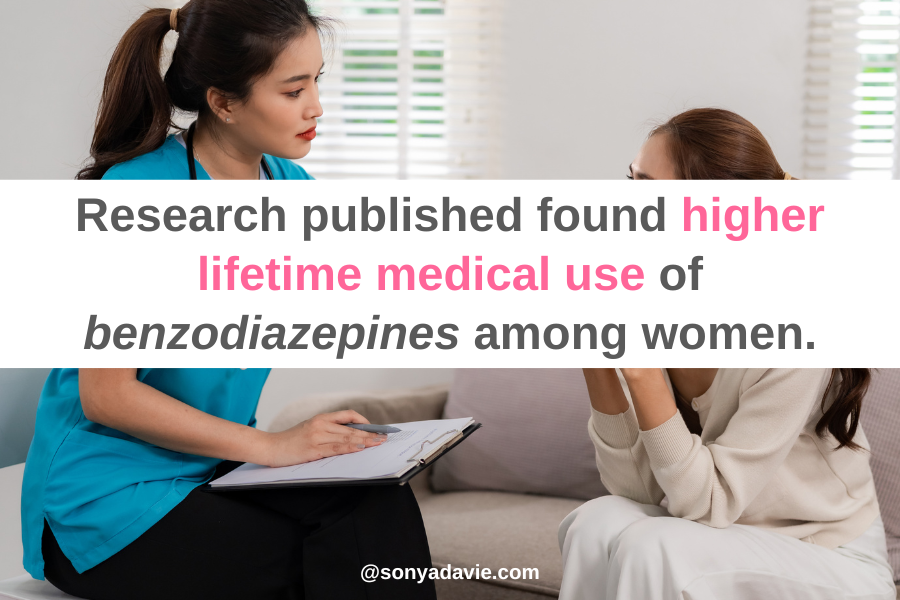
In one national sample, lifetime medical use of benzodiazepines was 5.6% in women vs. 3.9% in men, and non‑medical use was also higher in women (8.1% vs. 6.4%). (Source)
A 2020 study on adults with substance use disorders (SUDs) found that 58% of women vs. 44% of men had received benzodiazepine prescriptions. (Source)
Put simply, women are more likely to be on psychiatric medications, and more likely to be on multiple psychiatric medications at once.
But… how did we get here?
Let’s Look Beneath the Prescription Pad
From a trauma-informed, integrative lens, it isn’t enough to say, “Women are more anxious and depressed.”
We have to ask why women’s distress shows up in the healthcare system as prescriptions at such high rates.
1. The Gendered Load of Stress and Trauma
Women live in bodies and roles that carry a unique mix of pressures: caregiving expectations, wage gaps, discrimination, chronic microaggressions, sexual harassment, and gender‑based violence.
Many women are the emotional hub of their families, managing invisible labor around children, aging parents, and household logistics, often while also working outside the home. (Source)
When that level of chronic stress, grief, or trauma shows up as insomnia, panic, or low mood, it is often labeled a disorder during a brief appointment. The prescription pad then becomes the primary response to what is, at its core, a nervous system reacting appropriately to overload.
2. Diagnostic Patterns and “Female” Presentations
Research consistently shows women are diagnosed with depression and anxiety disorders at higher rates than men.
Women are also more likely to present with somatic symptoms (body-based) headaches, fatigue, gastrointestinal distress, and body pain.
Once “generalized anxiety disorder” or “major depressive disorder” appears in the chart, clinical pathways often move quickly toward antidepressants or benzodiazepines as first-line treatments.
Sometimes medication is appropriate and deeply helpful.
But underlying contributors like trauma history, hormone shifts, thyroid dysfunction, inflammation, and nutrient deficiencies are not always thoroughly explored before medication is started. (Source)
3. More Contact with the Healthcare System
Women, on average, access healthcare more frequently than men, particularly during reproductive years and midlife. More visits mean more opportunities for screening — and more opportunities for prescribing. (Source)
In many settings, providers are under time pressure. It is faster and easier to write a script than to sit with the complexity of a woman’s life: the abusive relationship, the food insecurity, the unprocessed trauma, the perimenopausal hormonal shifts, the unrelenting caregiving demands.
Medication may be offered with good intentions. But without deeper assessment, it can become a way of quieting symptoms rather than listening to what they’re communicating.
4. Hormones and Life Transitions
From menstrual cycles to pregnancy, postpartum, perimenopause, and menopause, women experience hormonal fluctuations that significantly influence mood, sleep, and cognition.
The National Institute of Mental Health recognizes the connection between reproductive transitions and mood disorders. (Source)
Yet hormone health, thyroid function, inflammatory markers, and nutrient status are not always fully integrated into mental health evaluations.
PMS, PMDD, postpartum depression, and perimenopausal mood changes are very real and deserve care. But they are frequently met with rapid prescriptions (antidepressants or sedatives) rather than comprehensive, integrative support plans.
The Cost of a Medication-First Culture
Medication can be life‑saving. For many women, an antidepressant or anti‑anxiety medication has helped them function, care for their families, or survive periods of intense distress. This is important to honor.
The concern is not that medication is ever used.
It’s often used first — and sometimes alone.
Higher prescribing means higher cumulative exposure to side effects (weight gain, sexual side effects, emotional numbing, withdrawal effects, cognitive changes), and for benzodiazepines, a real risk of dependence and difficult tapers.
Studies of psychotropic poisonings and prescription overdoses show women are overrepresented, which likely reflects, at least in part, higher overall prescribing and polypharmacy.
Long‑term benzodiazepine use is especially concerning: in some older populations, 13% of women vs. 5% of men were long‑term users, years or decades on medications that were originally intended for short‑term use. (Source)
What Women Deserve Instead
An integrative, trauma-informed approach does not demonize medication.
It repositions it.
That means:
- Deep assessment of nervous system state, trauma history, attachment patterns, and current safety.
- Attention to nutrition, gut health, sleep, movement, and inflammation, all of which can impact mood, anxiety, and cognition.
- Screening and support for hormonal shifts across the lifespan, from cycle‑related mood changes to perimenopause.
- Exploration of social determinants: racism, sexism, financial stress, caregiving load, and lack of support.
- Access to psychotherapy, somatic and body‑based work, nervous system regulation tools, group support, and community — not as last resorts if medication “fails,” but as core components of care.
When women are heard, validated, and offered a full spectrum of options, some will still choose medication, and that can be an informed, empowered choice.
Others may discover they need rest. Boundaries. Trauma processing. Hormonal support. Nourishment. Community. Often, they need both.
As we celebrate women this month, we must also advocate for something deeper: care that sees the whole woman — not just her symptoms.





+ show Comments
- Hide Comments
add a comment