


You used to handle the noise. The packed restaurants. The back-to-back meetings. The kids, the career, the family text threads that never stop.
But somewhere around your 40s or maybe it crept in during your late 30s — something shifted.
Now the grocery store fluorescents make you want to cry. A crowded room drains you for days. Certain sounds feel like sandpaper on your nervous system. You snap at people you love and don’t know why. You feel overstimulated by your own life.
You are not losing your mind. You are not “too sensitive.” And this is absolutely not in your head.
What’s happening has a “name” — and a biological explanation. Let’s talk about it.
First, What Is Sensory Overload?
Sensory overload happens when your nervous system receives more stimulation than it can process at one time. Sounds, light, touch, smell, emotion, social input — all of it floods in, and your brain essentially short-circuits trying to manage the volume.
For highly sensitive women (HSPs — a documented neurobiological trait affecting roughly 20% of the population), this threshold is already lower than average.
But for women in perimenopause or midlife?
That threshold can drop even further and the reasons are deeply physiological.
Read Here: What is a Highly Sensitive Person?
Why Sensory Overload Gets Worse After 40: The Hormonal Link
Here’s what most doctors don’t tell you at your annual exam:
estrogen and progesterone are not just reproductive hormones.
They are neuroactive compounds that directly regulate your nervous system, stress response, sensory processing, and emotional regulation.
When they start to fluctuate, as they do during perimenopause, which can begin as early as the late 30s, everything changes.
What the research shows:
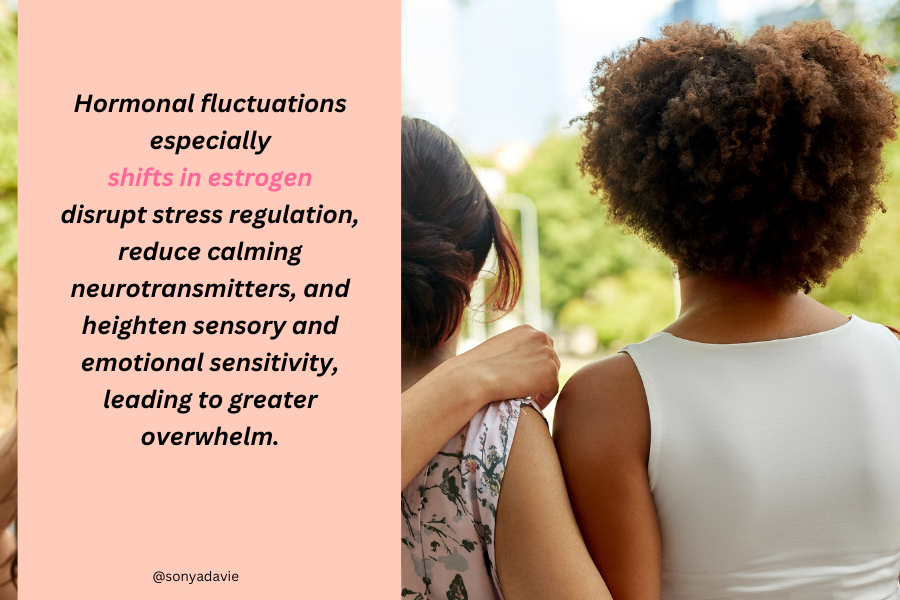
→ Estrogen modulates the HPA axis — your body’s primary stress regulation system. When estrogen fluctuates unpredictably, your stress response becomes less regulated. Reactions arrive faster, feel bigger, and take longer to resolve. (Source)
→ Falling estrogen decreases GABA activity, the brain’s main calming neurotransmitter. Less GABA means more reactivity, more anxiety, and a narrower window before overwhelm hits. (Source)
→ Changes in estrogen levels can lead to increased auditory sensitivity, making everyday sounds seem louder and more intrusive.
→ Hormonal fluctuations can also increase tactile sensitivity. Fabrics, textures, and even the feeling of clothing that were once comfortable may now cause real discomfort.
→ Perimenopausal estradiol fluctuation increases sensitivity to psychosocial stress, including exaggerated feelings of anger and emotional rejection (NCBI, 2019).
In short: the very chemistry that once helped buffer your nervous system is now destabilized.
And if you were already a highly sensitive person? The amplification can feel seismic.
Signs This Is Happening to You
This isn’t just about being “stressed.”
The symptoms of sensory overload in midlife women are specific:
- Sounds feel physically painful or unbearably loud
- Bright lights trigger headache, irritability, or a desperate need to escape
- You feel drained, not just tired, after social interactions
- Crowded spaces (stores, events, offices) feel like emergencies
- Emotional input from others — even people you love — feels like too much
- You have rage or meltdown responses that feel out of proportion
- Brain fog makes it hard to filter or prioritize incoming information
- You need significantly more downtime than you used to
If you nodded along to several of these, you are not broken. Your nervous system is under real physiological strain — and it is asking for a different kind of support than what you’ve been giving it.
What Most Conventional Advice Gets Wrong
The standard response to these symptoms is often therapy, meditation, or medication for anxiety or depression. And while those tools can have their place, they rarely address what’s actually happening at the root level.
Sensory overload in midlife women is not a mindset problem. It is not a willpower problem. It is a nervous system regulation problem, compounded by hormonal chemistry, often layered on top of a lifetime of masking, over-functioning, and ignoring what your body needed.
Thinking your way out of a dysregulated nervous system doesn’t work, because you cannot cognitively override a physiological state. You have to move through it.
What Actually Helps: Regulation from the Body Up
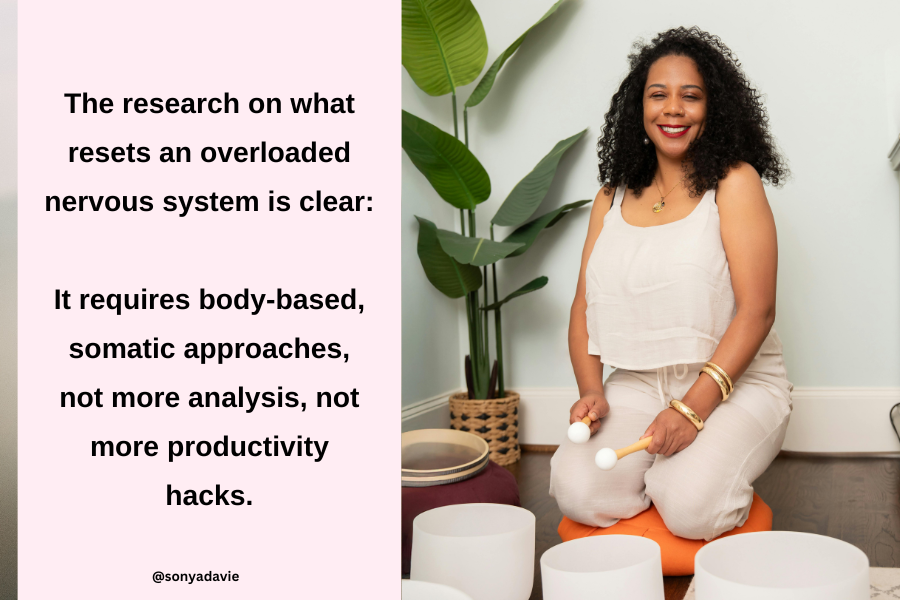
The research on what resets an overloaded nervous system is clear:
It requires body-based, somatic approaches, not more analysis, not more productivity hacks.
Here is what the evidence supports:
1. Rhythmic, expressive movement
Movement that combines rhythm, breath, and joy is one of the most direct pathways to nervous system regulation. It activates the ventral vagal system (your safety state), releases stored stress hormones, and shifts the body out of the freeze or fight-or-flight loop that sensory overload triggers.
This is not about high-intensity exercise that further spikes cortisol. It is about movement that is expressive, rhythmic, and feels good in your body — exactly the kind your system is craving.
2. Nervous system tools you can reach for daily
Vagus nerve activation, breathwork, somatic grounding, and sensory regulation tools are not optional extras for sensitive women in midlife. They are maintenance. The nervous system is like a muscle — it builds capacity through consistent, intentional practice, not just crisis management.
3. Community and co-regulation
One of the most underutilized regulatory tools is safe human connection. Co-regulation — the way our nervous systems literally calm in the presence of another regulated nervous system — is biology, not self-help. Isolation amplifies overload. The right community heals it.
📍 Ready to give your nervous system what it’s actually asking for?
Explore my events page for upcoming movement experiences designed for women who are done feeling overstimulated, burned out, and disconnected, and ready to feel grounded, regulated, and fully in their bodies again.
In summary:
Sensory overload in women over 40 is not a personality flaw.
It is not anxiety disorder masquerading as sensitivity. And it is not something you should just power through.
It is a nervous system that has been running on fumes, now contending with real hormonal and neurological shifts that demand a different approach to care.
You deserve support that meets you at the level of your biology — not support that tells you to try harder or calm down.
Start where your body is asking you to start: with movement, with tools, with community, and with the radical understanding that your sensitivity is not your problem. It is your power.
―――
References & Research:
Brinton, R.D. et al. (2015). Perimenopause as a neurological transition state. Nature Reviews Endocrinology. PMC9934205
Gordon, J.L. et al. (2019). Estradiol Fluctuation, Sensitivity to Stress, and Depressive Symptoms in the Menopause Transition. PMC6581734
National Sensory Network. Understanding Sensory Processing and Menopause. nationalsensorynetwork.org
Aerchitect (2026). Perimenopause & the Nervous System: Why You Feel Dysregulated & What Helps. aerchitect.com
Bjelland, J. (2025). Survey Results: Perimenopause and Menopause in Sensitive and Neurodivergent Women. juliebjelland.com





+ show Comments
- Hide Comments
add a comment