


Clutter is often treated as a personal shortcoming… something to “just deal with,” organize better, or power through.
But research in neuroscience, psychology, and stress physiology tells us something important:
Clutter is a form of constant sensory input that directly affects the brain and nervous system.
And for people with ADHD, trauma histories, or those who identify as Highly Sensitive People (HSPs), clutter can:
- Increase stress hormones
- Disrupt focus and working memory
- Heighten emotional reactivity
- Contribute to anxiety, shutdown, or burnout
This isn’t about being messy or unmotivated.
It’s about how different brains and nervous systems process stimulation.
In this post, explore how clutter affects mental health through a brain-based, trauma-informed lens… and why some people feel its impact so much more deeply than others.
How Clutter Affects the Brain and Attention
Your brain has a limited capacity for processing visual information. Every object in your environment competes for attention, even when you’re not consciously looking at it.
Clutter increases:
- Visual competition in the brain
- Cognitive load
- Mental fatigue
- Difficulty sustaining attention
Your visual system is constantly filtering what matters from what doesn’t, and that filtering requires energy and executive control.
Yes… Clutter isn’t just “background noise.”
Your brain is actively working harder just to function in a cluttered space.
Clutter as a Chronic Stressor on the Nervous System
Your nervous system continuously scans your environment for cues of safety or threat. A cluttered or unfinished space can register as unresolved, chaotic, or demanding. (Source)
Research has linked cluttered home environments with:
- Higher daily cortisol levels
- Lower feelings of rest and restoration
- Increased depressed mood and stress
Over time, this can keep the nervous system stuck in a low-grade stress response.
If your space doesn’t feel calming, your body may never fully shift into rest-and-repair mode.
Related Post: The Vicious Cycle of Clutter and Mental Health You Need to Know About
Why Clutter Is Especially Challenging for ADHD Brains
ADHD isn’t a lack of motivation. It’s a difference in self-regulation and executive functioning, processes largely managed by the prefrontal cortex.
Executive functions include:
- Task initiation
- Planning and sequencing
- Working memory
- Sustained attention
- Emotional regulation
Clutter dramatically increases the number of decisions the brain must make, raising the mental effort required just to begin.
This often leads to:
- Procrastination or avoidance
- “Piles” instead of systems
- Overwhelm and shutdown
- Shame-based self-talk
For ADHD brains, clutter isn’t just inconvenient — it creates a real cognitive barrier to action.
Highly Sensitive People (HSPs): Why Clutter Feels So Overwhelming
Highly Sensitive People (HSPs) are described in research as having Sensory Processing Sensitivity (SPS), a biologically based temperament trait.
HSPs tend to:
- Process sensory and emotional input more deeply
- Become overstimulated more easily
- Experience stronger emotional responses
- Need more downtime to recover
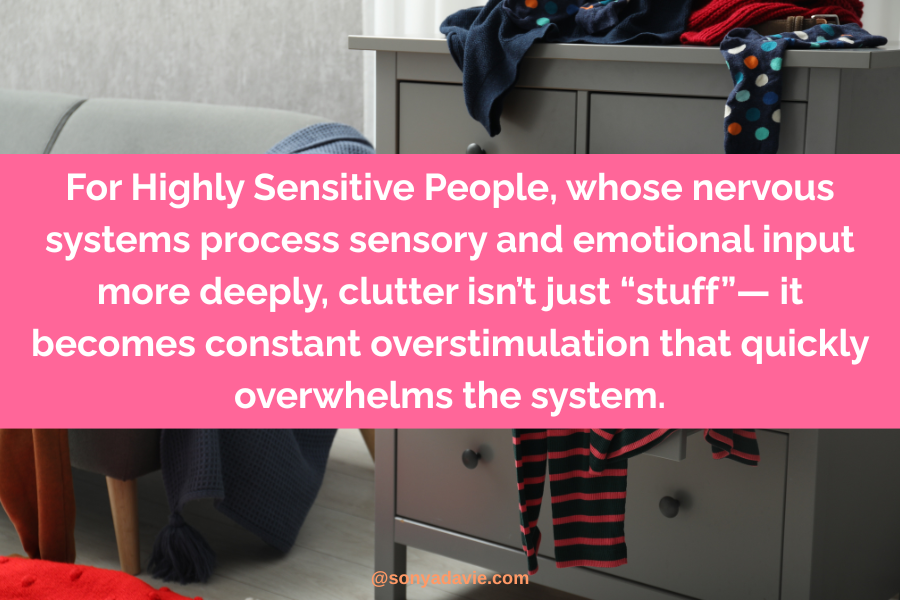
Clutter increases sensory input — visual noise, emotional associations tied to objects, and environmental unpredictability.
If your nervous system takes in more information, clutter becomes more than “stuff” — it becomes overstimulation.
The ADHD + HSP Overlap: When the Load Doubles!
Many people experience traits of both ADHD and high sensitivity. This combination can create a painful loop:
- You need calm to regulate
- But struggle to create or maintain it
- You become overstimulated
- Then blame yourself for not keeping up
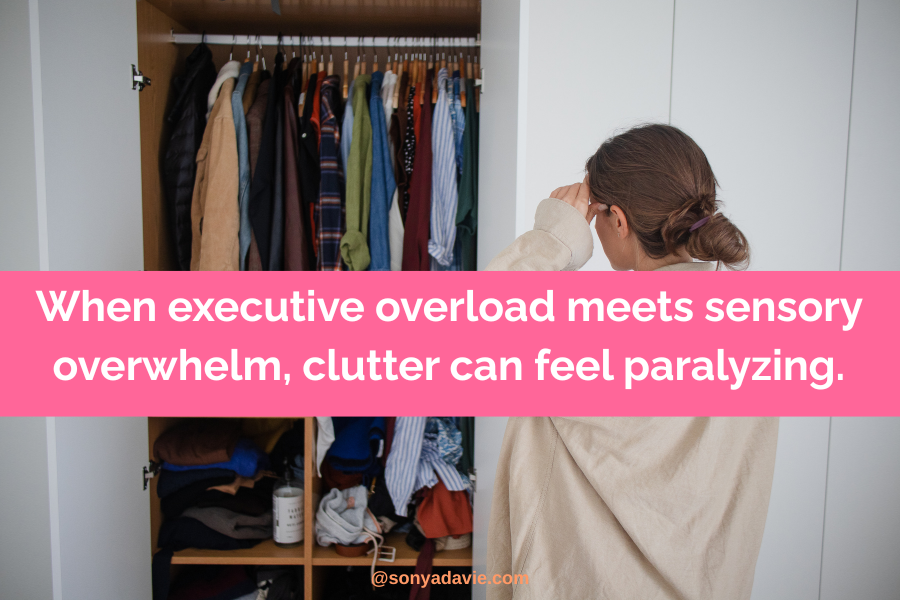
This isn’t a failure of discipline or willpower. It’s a mismatch between nervous system needs and environmental demands.
Trauma, Safety, and the Physical Environment
For individuals with trauma histories, the environment plays a powerful role in nervous system regulation.
Clutter can:
- Increase hypervigilance
- Reinforce feelings of chaos or lack of control
- Signal “unfinished” or unsafe conditions
From a trauma-informed perspective, external order can support internal regulation — especially when internal regulation feels hard to access.
Your space can either support healing or quietly work against it.
A Nervous-System-Friendly Approach to Reducing Clutter
This approach focuses on regulation first, organization second.
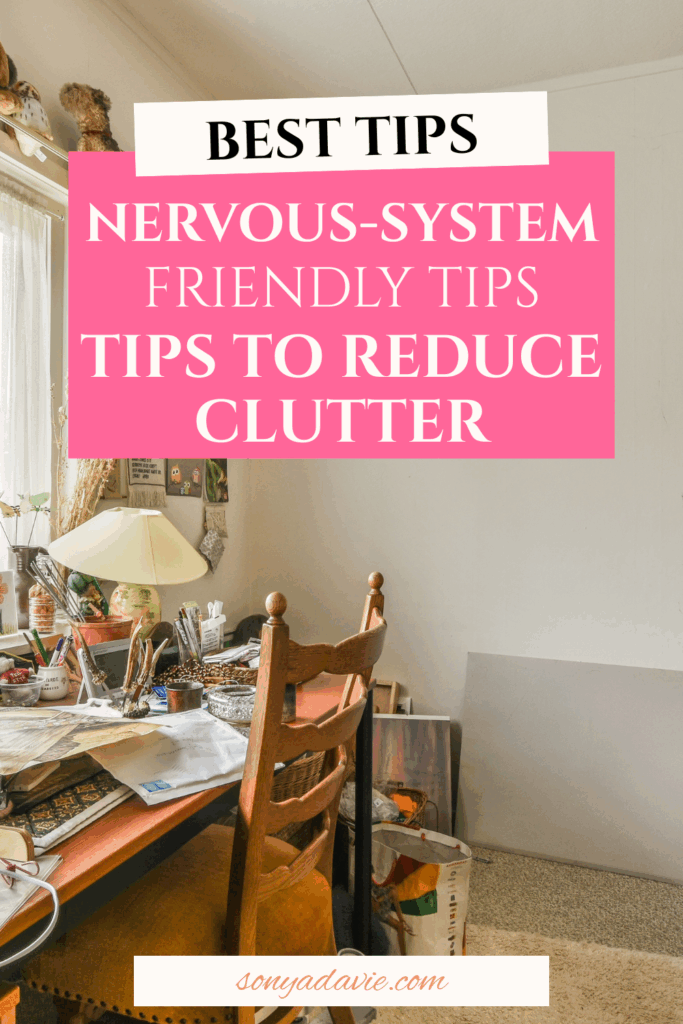
1. Reduce visual input (not perfection)
Hide clutter before sorting it.
- Use bins, baskets, or drawers
- Decrease what you see, not necessarily what you own
2. Time-cap decluttering
Work in 7–12 minute intervals, then stop on purpose.
- Prevents overwhelm
- Builds trust and safety with your body
3. Use low-demand systems
- Hooks instead of hangers
- Open bins instead of stacked containers
- Broad categories instead of micro-sorting
4. Create one “calm anchor.”
Choose one small space, your nightstand, a desk corner, or entryway that stays relatively clear.
Even one regulated space can help your nervous system exhale.
A Sanctuary Starts Here!!!
If you’re feeling stuck, don’t worry… the right tools make all the difference. Simple things like storage bins, baskets, or label makers can help you organize your space without overwhelm. These little helpers can turn that first daunting step into a satisfying, manageable action.
And while you’re decluttering, why not sprinkle in a few wellness touches to enhance your environment?

Think calming essential oils, a cozy throw to invite warmth, or a gentle diffuser to help you unwind after a long day. With the right combination of home organization and wellness essentials, you’ll feel inspired to take small, consistent steps toward clarity and calm.
Check out my favorite home organization and wellness picks for the tools and inspiration you need to simplify decluttering and elevate your space:
With these resources, transforming chaos into calm becomes not just possible, but actually enjoyable, one space at a time.
Your clutter-free journey can be a gentle act of self-care, creating spaces where relaxation, recharge, and comfort from the outside world are always within reach.
My Final Takeaway:
“Clutter Is a Nervous System Issue”
Clutter is not a moral failing. It’s not a character flaw. And it’s not resolved through shame.
For ADHD brains, HSPs, and trauma-affected nervous systems, clutter is deeply connected to how the brain processes stimulation, stress, and safety.
When decluttering is approached through a neuroscience- and trauma-informed lens, it becomes less about discipline — and more about compassion, support, and regulation.
And that shift matters.
Key Research & Scientific References
- Saxbe, D. E., & Repetti, R. L. (2010). No Place Like Home: Home Tours Correlate With Daily Patterns of Mood and Cortisol. Personality and Social Psychology Bulletin.
- McMains, S. A., & Kastner, S. (2011). Interactions of Top-Down and Bottom-Up Mechanisms in Human Visual Cortex. Journal of Neuroscience.
- Whitney, D., & Levi, D. M. (2011). Visual Crowding: A Fundamental Limit on Conscious Perception. Trends in Cognitive Sciences.
- Barkley, R. A. (2012). Executive Functions: What They Are, How They Work, and Why They Evolved. Guilford Press.
- Aron, E. N., & Aron, A. (1997). Sensory-Processing Sensitivity and Its Relation to Introversion and Emotionality. Journal of Personality and Social Psychology.
- Aron, E. N., et al. (2012). Sensory Processing Sensitivity: A Review in the Light of the Evolution of Biological Responsivity. Personality and Social Psychology Review.
- Acevedo, B. P., et al. (2014). The Highly Sensitive Brain: An fMRI Study of Sensory Processing Sensitivity. Brain and Behavior.




+ show Comments
- Hide Comments
add a comment