


Every January, many of us set heartfelt intentions like:
“I want to be calmer.”
“I won’t overreact anymore.”
“This year, I’m going to regulate my emotions better.”
And then… life happens.
A stressful email. A familiar family trigger. A few nights of poor sleep. Hormonal shifts. Work overload. Suddenly, emotions feel louder, reactions come quicker, and that inner voice creeps in:
“Why can’t I get this right?”
Here’s the truth… Emotional regulation doesn’t fail because you aren’t trying hard enough.
It fails because New Year’s resolutions aren’t designed for how the nervous system actually works, especially under stress.
Emotional regulation isn’t willpower — it’s physiology
From a clinical and nervous-system lens, emotional regulation depends on something called your window of tolerance. This is the zone where your system can experience emotion without becoming overwhelmed or shut down.
When stress pushes you outside that window, your brain shifts into survival mode.
In those moments:
- the prefrontal cortex (logic, impulse control, reflection) goes offline
- the body prioritizes protection, not self-improvement
- emotional reactions happen faster than conscious thought
So when you think, “I should know better by now,” what you’re actually experiencing isn’t personal failure, it’s nervous system overload.
This is why trying to “think your way” into calm rarely works when stress is high. The system needs support before insight can land.
How perfectionism quietly sabotages emotional growth
This is where many emotionally aware, high-functioning people get stuck.
They approach emotional regulation with perfectionism:
- “If I get triggered, I’ve failed.”
- “If I feel anxious, I’m doing something wrong.”
- “If I snap or shut down, I’m back at square one.”
Clinically, this creates a loop that looks like this:
- An emotion arises
- Self-judgment kicks in
- Nervous system activation increases
- Regulation becomes harder
- Eventually, the person stops trying altogether
Emotion suppression and self-criticism don’t calm the nervous system. They actually intensify it.
Sustainable regulation requires safety, not pressure.
Why traditional resolutions don’t support emotional regulation
Most New Year’s resolutions:
- Assume consistency without emotional disruption
- Don’t account for accumulated stress
- Treat setbacks as personal failure
- Focus on outcomes (“stay calm”) instead of capacity
But stress load matters. Poor sleep, chronic worry, trauma history, hormonal changes, sensory overload — these all reduce your ability to regulate in the moment.
Without built-in recovery, even the tools you know can feel completely inaccessible.
This isn’t a mindset issue. It’s a capacity issue.
What actually helps emotional regulation (without self-judgment)
1. Choose a theme, not a rule
Instead of rigid goals, try a nervous-system-friendly theme.
Rather than:
“I will always stay calm.”
Consider:
- The Year of Nervous System Safety
- The Year of Emotional Flexibility
- The Year of Responding, Not Reacting
Themes guide behavior while allowing for real human emotions.
2. Redefine what “regulated” actually means
Regulation does not mean:
- Never getting triggered
- Never feeling anxious or overwhelmed
- Always responding perfectly
From a clinical lens, regulation looks more like:
- Noticing activation sooner
- Recovering more quickly
- Shortening the emotional hangover
- Repairing instead of spiraling
Progress is often quieter than perfection — but far more meaningful.
3. Use minimum-effective regulation practices
Your nervous system doesn’t need long routines to shift state. Sometimes 60–120 seconds is enough.
Try:
- One slow exhale that’s longer than your inhale
- Relaxing your jaw, tongue, and shoulders
- Grounding your feet into the floor
- Naming what’s happening: “My system is activated, not broken.”
Small, repeatable moments of regulation are far more effective than ideal routines that never happen.
4. Pre-decide your regulation with If–Then plans
When stress is high, decision-making is hard. This is why pre-deciding matters.
Examples:
- If I feel emotionally flooded, then I lengthen my exhale.
- If I start spiraling, then I ground in my body before thinking.
- If I react, then I repair without self-attack.
This removes pressure from the moments when your brain has the least capacity.
5. Treat emotional setbacks as information — not failure
From a nervous-system perspective, emotional flare-ups usually mean:
- Stress exceeded recovery
- A boundary or pause was missed
- Your system needs support
When emotions are no longer moralized, regulation becomes sustainable.
The foundation most people miss: Stress Recovery
You cannot regulate emotions in a system that never recovers.
Stress recovery:
- Lowers baseline reactivity
- Widens the window of tolerance
- Builds emotional resilience
- Makes regulation tools accessible again
This is why emotional skills alone often aren’t enough, and why so many people feel like they’re “doing everything right” but still struggling.
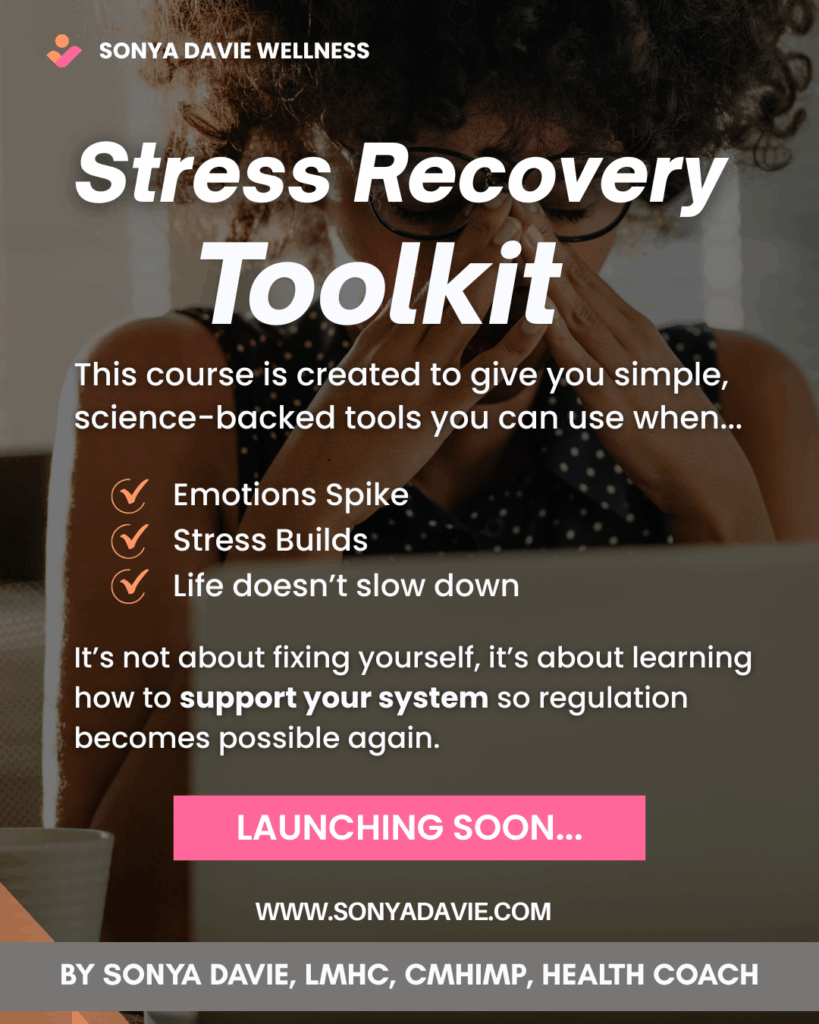
It’s also why I created the Stress Recovery Toolkit — to offer nervous-system-based tools that work in real moments, not just ideal ones.
Because emotional regulation isn’t about controlling your feelings. It’s about supporting the system that carries them.
A Resolution-Free Emotional Regulation Plan
Instead of a New Year’s resolution, try this:
Theme: Emotional Safety Over Perfection
Daily regulation practice (≤ 2 minutes): __________
Stress recovery boundary: __________
If–Then plan:
If I feel activated, then I __________.
Restart rule: “I return without judgment.”
My Final thoughts…
If emotional regulation has felt hard in the past, it’s not because you lack insight, discipline, or effort.
It’s because your nervous system has been doing its best under pressure.

If regulation has felt harder than it “should,” that’s not a personal shortcoming, it’s a sign your nervous system needs recovery, not more pressure.
This is where the Stress Recovery Toolkit comes in!
This course is designed to give you simple, science-backed tools you can use when emotions spike, stress builds, and life doesn’t slow down. It’s not about fixing yourself, it’s about learning how to support your system so regulation becomes possible again.
The toolkit launches soon, and it’s meant to meet you exactly where you are.





+ show Comments
- Hide Comments
add a comment