


By Sonya Davie, LMHC, INHC, CMHIMP · Founder, Sonya Davie Wellness
June is Men’s Health Month — and if we’re being honest, it’s also the month where well-meaning health messaging tends to stay safely on the surface.
Eat better. Exercise more. See your doctor.
But there’s a deeper conversation we need to have. One that most men are never invited into.

It’s about testosterone — not just as a symbol of masculinity, but as a critical driver of mental health, emotional regulation, cognitive function, and quality of life.
For many men, changes in mood, increased irritability, persistent fatigue, brain fog, or a loss of motivation are often dismissed as a normal part of getting older, working too hard, or simply having a lot on their plate.
What many men don’t realize is that these changes may not be solely psychological. They may also be connected to important physiological shifts happening within the body.
Men Experience Hormonal Changes Too
— We Just Don’t Talk About It
Most people have heard of menopause. Far fewer have heard of andropause or, more accurately, late-onset hypogonadism — the gradual hormonal shift that men begin to experience as early as their mid-30s.

Unlike the more abrupt hormonal changes women experience, men’s testosterone decline is slower and quieter. But quiet doesn’t mean insignificant.
Research shows that total testosterone begins declining at approximately age 35, with free testosterone (the biologically active form) dropping at a rate of about 1.3% per year. (Source)
A landmark 2021 study of more than 4,000 men documented a nearly 25% decrease in average total testosterone levels among young men ages 15–40 over just a 17-year period. This isn’t just an aging issue… It’s a population-wide trend. (Source)
Yet men are rarely told this is happening. Instead, they’re told to push through. Work harder. Sleep less. Handle it.
Testosterone Is Not Just About Sex Drive
When most people hear the word testosterone, they think about muscle mass, athletic performance, or sex drive.
While testosterone certainly plays a role in these areas, its impact extends far beyond them.

It interacts directly with dopamine pathways (motivation, pleasure, drive), serotonin systems (mood regulation), and the stress-response network involving cortisol. It influences:
- Emotional resilience and frustration tolerance
- Cognitive clarity, focus, and memory
- Sense of purpose and identity
- Sleep architecture and circadian rhythm
- Bone density and metabolic function
- Inflammation and immune regulation
When testosterone levels drop or are chronically suppressed, the psychological effects can be significant and deeply personal.
The Mental Health Connection Men Aren’t Being Told About
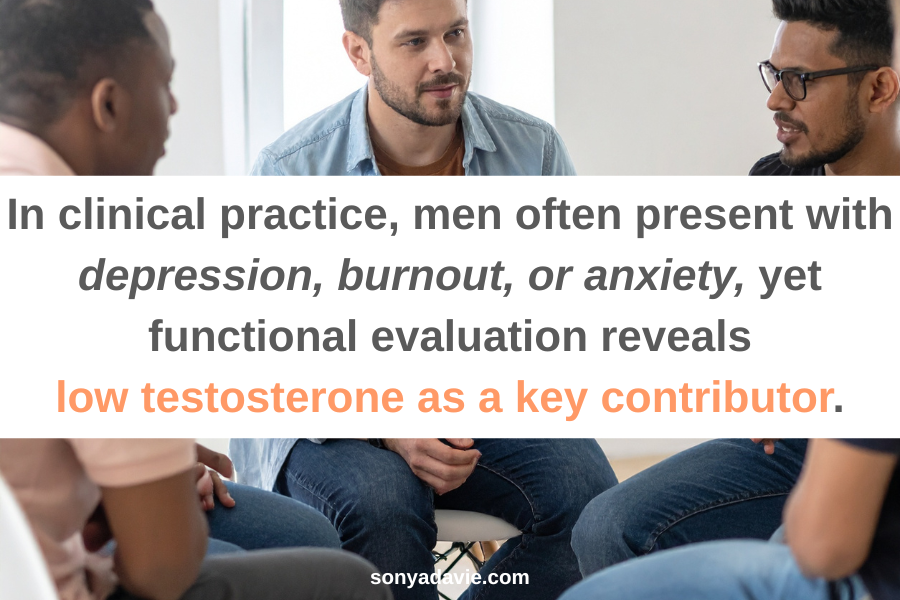
In clinical practice, I regularly see men who present with what looks like depression, burnout, or anxiety — only for a functional evaluation to reveal that suboptimal testosterone is a major contributing factor.
The symptoms overlap almost completely:
- Low mood or persistent sadness
- Irritability and reduced frustration tolerance
- Brain fog and difficulty concentrating
- Loss of motivation or passion
- Fatigue that sleep doesn’t fix
- Decreased confidence or a diminished sense of self
One study of 278 men aged 45 and older found that 21% of men with low testosterone developed depression over a two-year period compared to just 7% of men with normal levels. That’s three times the risk. (Source)
Yet in many clinical settings, hormone levels are never assessed.
Men receive antidepressants or anxiety medication without anyone asking: What is actually driving this?
The silence around men’s hormonal health isn’t just cultural; it has real clinical consequences.

When men internalize mood changes, loss of drive, or emotional flatness as personal failure rather than physiological shifts, they are less likely to seek help. And when clinicians don’t ask the right questions, the root causes stay hidden.
Why Monitoring Your Testosterone Matters
Routine men’s health screenings typically check cholesterol, blood pressure, and blood glucose. Hormone health is rarely on the list unless symptoms become severe enough that something is obviously wrong.
But here’s the functional psychiatry perspective: waiting until something is obviously wrong is not a health strategy. It’s crisis management.
Monitoring testosterone matters because:
- It changes the clinical picture. Knowing whether low or suboptimal testosterone is present helps distinguish between primary psychiatric conditions and hormonally driven symptoms, which require different interventions.
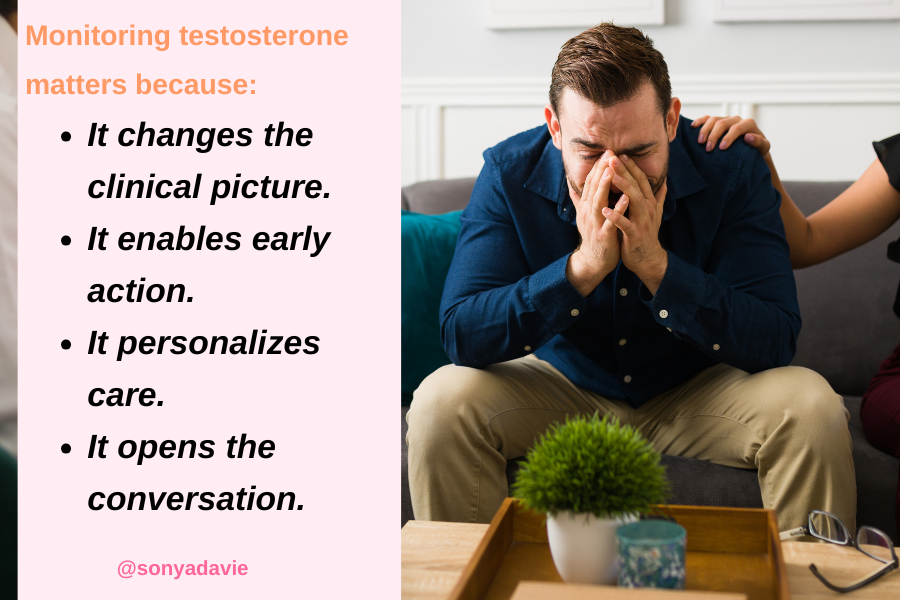
- It enables early action. Addressing hormonal shifts before they become severe protects long-term mental, metabolic, and cardiovascular health.
- It personalizes care. A comprehensive hormone panel, including total testosterone, free testosterone, SHBG (sex hormone-binding globulin), cortisol, thyroid function, and inflammatory markers, gives a far more complete picture of what’s driving a man’s symptoms.
- It opens the conversation. When men understand the biology behind their experience, they’re more likely to engage with treatment, lifestyle changes, and ongoing monitoring.
The Stress Factor: The Hidden Testosterone Thief
This is where things get urgent and where so many men are stuck in a cycle they don’t recognize.
Cortisol and testosterone share an inverse relationship.

When you experience stress, whether physical, emotional, or psychological, your hypothalamic-pituitary-adrenal (HPA) axis activates and cortisol floods the system.
In short bursts, this is adaptive. The problem is chronic stress.
When stress becomes ongoing, cortisol levels remain persistently elevated.
And this is where the cycle becomes dangerous:
Chronic stress → elevated cortisol
Elevated cortisol → suppressed testosterone production
Lower testosterone → increased fatigue, mood disruption, reduced stress resilience
Reduced resilience → heightened stress reactivity
And the cycle continues.
Research confirms that sleeping fewer than five hours per night itself is a form of physiological stress, which can reduce testosterone levels by 10–15% in otherwise healthy men. Modern life, with its 24/7 connectivity, sedentary demands, and compressed recovery time, is operating directly against men’s hormonal health. (Source)
This isn’t about willpower. It’s about biology.
An Integrative Approach: Supporting the Whole System
Optimizing testosterone isn’t only about replacement therapy. Before reaching for any pharmaceutical or supplement intervention, a functional psychiatry approach asks:
What lifestyle and physiological factors are driving this decline? And which are addressable?
Evidence-informed strategies include:
Strength and resistance training — one of the most well-documented natural supports for testosterone production.

Prioritizing restorative sleep — testosterone production is closely tied to deep sleep cycles; poor sleep is a direct suppressor.
Managing chronic stress — this is non-negotiable. Persistently elevated cortisol directly suppresses testosterone synthesis. Nervous system regulation is hormone regulation.
Nutritional support — zinc, magnesium, vitamin D, and essential fatty acids are foundational to testosterone production and neurotransmitter balance.
Reducing endocrine disruptors — environmental toxins found in plastics, pesticides, and personal care products interfere with hormonal signaling at the receptor level.
Addressing gut health and inflammation — inflammatory load directly impacts hormonal and neurotransmitter systems.
Each of these interventions doesn’t just support testosterone.
They support the nervous system, emotional regulation, and mental health because, from a functional psychiatry lens, these systems are never separate.
The Stress-Testosterone Connection Is Why I Created the Stress Recovery Toolkit.
Of all the lifestyle factors that suppress testosterone…
chronic stress is one of the most under-addressed and one of the most modifiable.
That’s exactly why I developed the Stress Recovery Toolkit: a mini-course designed to help you understand your stress response, regulate your nervous system, and break the cortisol cycle that’s quietly working against your hormonal and mental health.

This isn’t a generic stress management program. It’s built from an integrative and functional psychiatry framework designed to address the root, not just the symptom.
If you’re experiencing fatigue that won’t lift, mood changes that don’t make sense, brain fog, or a sense that you’re just not yourself anymore, chronic stress and cortisol dysregulation may be playing a much larger role than you realize.
👉 Get the Stress Recovery Toolkit here and start addressing the stress that’s silently affecting your hormones, your mood, and your life.
My Final Thoughts…
We’ve made real progress in normalizing conversations about women’s hormonal health.
It’s time to extend that same care and clinical curiosity to men.
Testosterone is not just about muscle or libido. It is a biological foundation for mood, motivation, cognition, resilience, and identity. When it declines and when chronic stress accelerates that decline, men deserve to understand what’s happening, to have language for their experience, and to access care that goes beyond surface-level treatment.
Mental health is not separate from hormonal health.
And you deserve both.





+ show Comments
- Hide Comments
add a comment