


By Sonya Davie, LMHC, INHC, CMHIMP · Founder, Sonya Davie Wellness
June is Men’s Health Month, and while conversations about physical health are important, there’s another issue affecting millions of men that urgently needs to be addressed…
Men’s mental health at WORK!
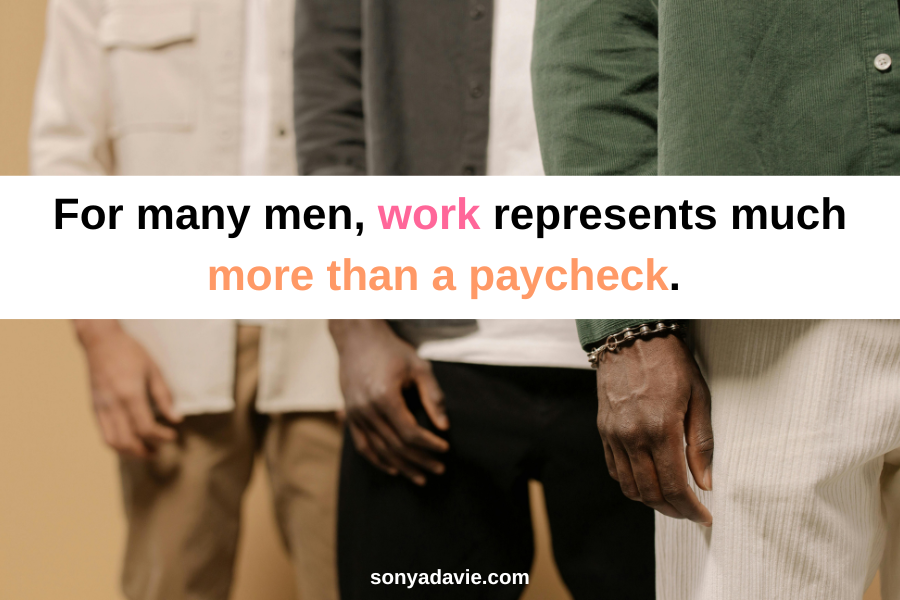
Back in 2017, a landmark survey made a quiet but striking headline: nearly a third of men with poor mental health blamed their jobs. The UK mental health charity Mind surveyed 15,000 people and found that 32% ofmen identified workplace stress as a primary cause of their mental health struggles… yet those same men were far less likely than women to take time off, talk to someone, or reach out for help.(Source)
Seven years later, the headline hasn’t changed. The crisis has only deepened.
The Numbers Don’t Lie…
Let’s start with where things stand today.
Roughly 12% of men experience a common mental health condition, such as anxiety or depression, at any given time. Yet fewer than half receive any form of treatment. At the same time, men die by suicide at around three to four times the rate of women, with middle-aged men consistently representing the highest-risk group.
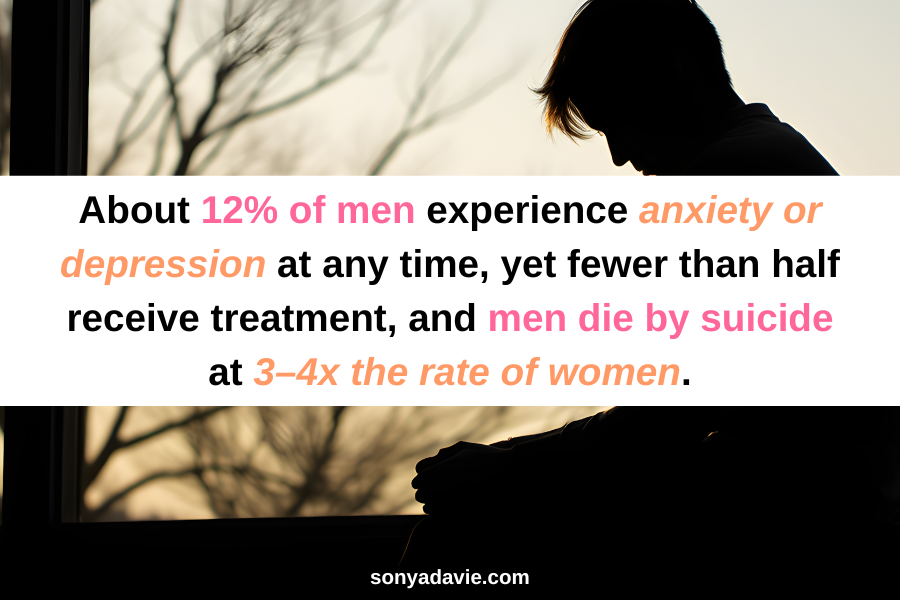
In the UK in 2023, this disparity is even more stark. According to the Office for National Statistics, men account for approximately three-quarters of all suicide deaths, highlighting a persistent and deeply concerning gender gap in mental health outcomes.(Source)
Workplace data mirrors this pattern.
The 2024 Workplace Health Report confirmed that over 1 in 3 men still report unhelpful stress at work… a figure that has remained largely unchanged since 2017. (Source)
This stability suggests the issue isn’t situational or temporary; it points to deeper, structural drivers within work culture, expectations, and access to support.
Related Post: What Men Need to Know About Testosterone, Mental Health, and the Stress That’s Making It Worse
Work Isn’t Just a Job for Men — It’s Identity
A lot of men don’t just “go to work.” Work is deeply tied to how they see themselves.
The 2025 Equimundo State of American Men report, one of the most comprehensive surveys of American men’s attitudes and well-being in recent years, found that 86% of men (and 77% of women) agree that being a provider is a defining trait of manhood. (Source)
So when work is going well, there’s stability, pride, and identity. For many, work is who they are!
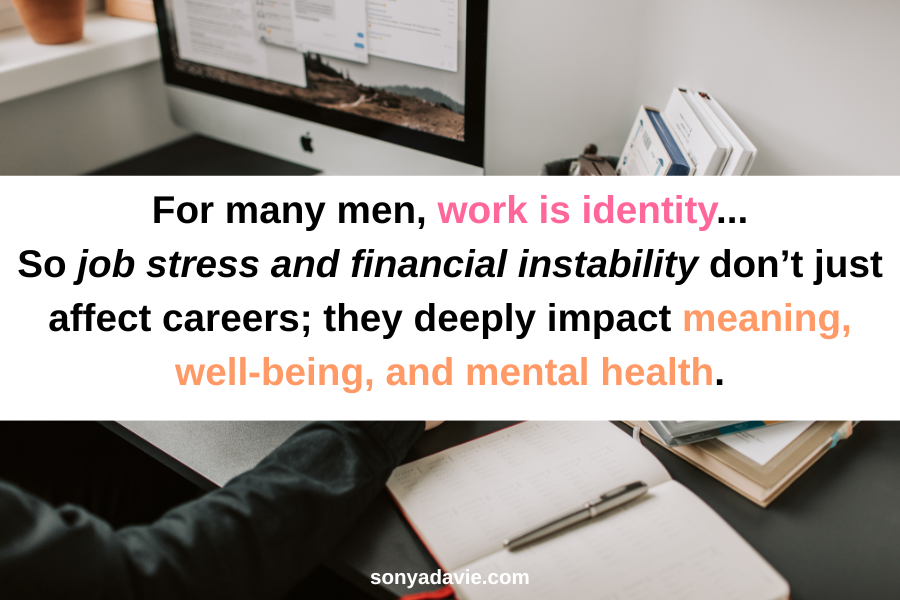
This means that when a job becomes a source of stress, unfulfillment, or instability, it doesn’t just affect productivity… it attacks identity.
The same report found that men who are not in the career they wanted are significantly less likely to feel that “life is full of meaning and purpose”.
Career dissatisfaction doesn’t stay at the office. It comes home. It sits at the dinner table. It keeps men awake at 2 am.
And when financial instability enters the picture? Men with financial stress are 16.3 times as likely to report recent suicidal ideation compared to 7.3 times for women in similar circumstances. That gap is hard to ignore.
The “Man Box” at Work: Why Men Don’t Speak Up
A big reason men struggle to seek help goes beyond workload?… It’s culture.
The 2017 Mind survey first highlighted “macho culture” at work as a major barrier to men opening up. Since then, researchers have refined this into what’s now called the “Man Box”, a set of rigid, unspoken rules men are often taught:
be strong, don’t show weakness, provide no matter what, handle it alone, and never ask for help.
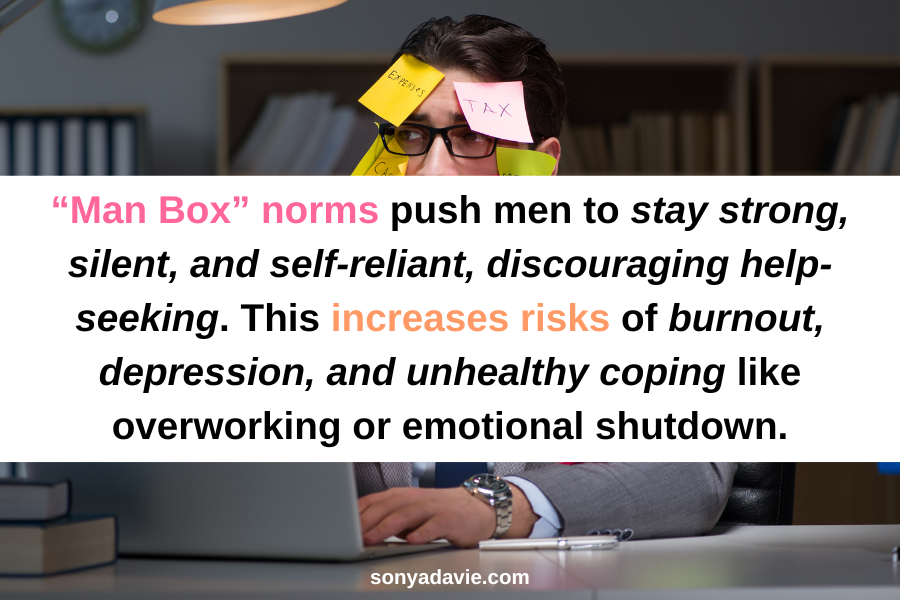
A major 2025 systematic review in the American Journal of Men’s Health found that adherence to traditional masculinity norms is one of the strongest predictors of low help-seeking in men. Those who most strongly internalize these norms are also more likely to experience depression, use substances as coping, and avoid support altogether. (Source)
Even more concerning, these expectations haven’t faded… they’ve intensified in many environments since 2017.
Despite growing awareness around men’s mental health, the internal pressure to “keep it together” has only deepened.
The result? Men suffer in silence — often in plain sight. Clinically, this shows up not as
tearfulness or withdrawal, but as irritability, substance use, over-working, risk-taking, and
aggression — externalizing symptoms that are easy to miss or misdiagnose.
The Workplace Is Often the Source — And the Barrier to Help
Here’s the cruel irony: the workplace is both where the mental health wound is created and where the support often feels out of reach.
A 2026 Spring Health survey of 1,500+ full-time employees found that men were 42% more likely than women to feel held back by manager resistance or discomfort when trying to access mental health support. They were also 32% more likely to feel confused about how to navigate benefits, and 28% more likely to cite privacy concerns as a barrier to getting help. (Source)
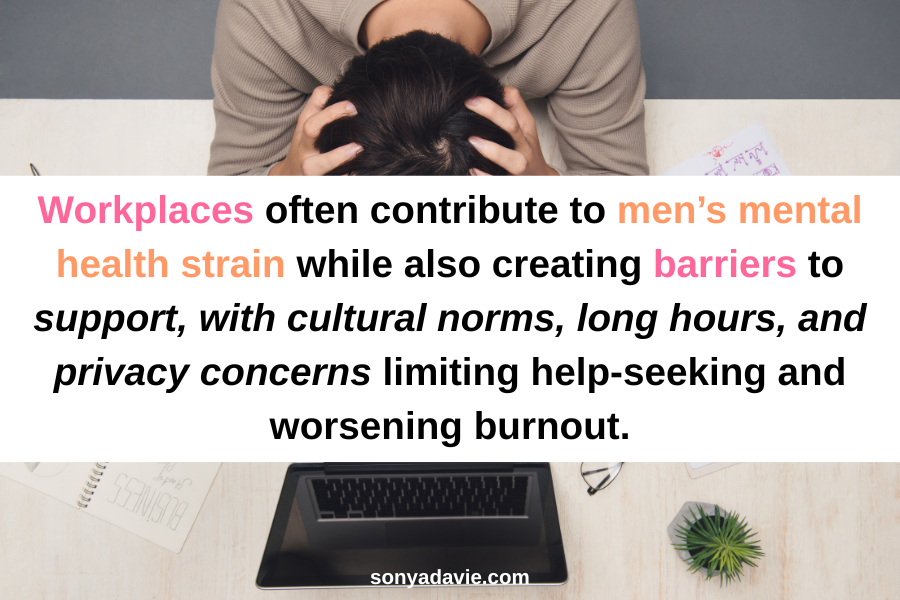
Research from Catalyst (2024) adds another layer. Workplaces where “manliness is policed” where stoicism, competition, and emotional restraint are rewarded directly contribute to burnout, sleep disruption, and poorer mental health in men.
And yet, 87% of men say they would actually prefer workplaces where empathy and kindness are welcomed. (Source)
In other words, the culture many men are expected to operate in is not the culture they want.
On top of that, men are more likely than women to be in full-time employment (85% vs. 61%) and work an average of 27% more hours (Source). That means greater exposure to chronic stressors: long hours, high demands, low autonomy, poor recognition, and strained team dynamics.
Certain Industries Carry a Heavier Weight
Not all work environments carry the same level of risk. High-demand, male-dominated industries often compound the pressure even further.
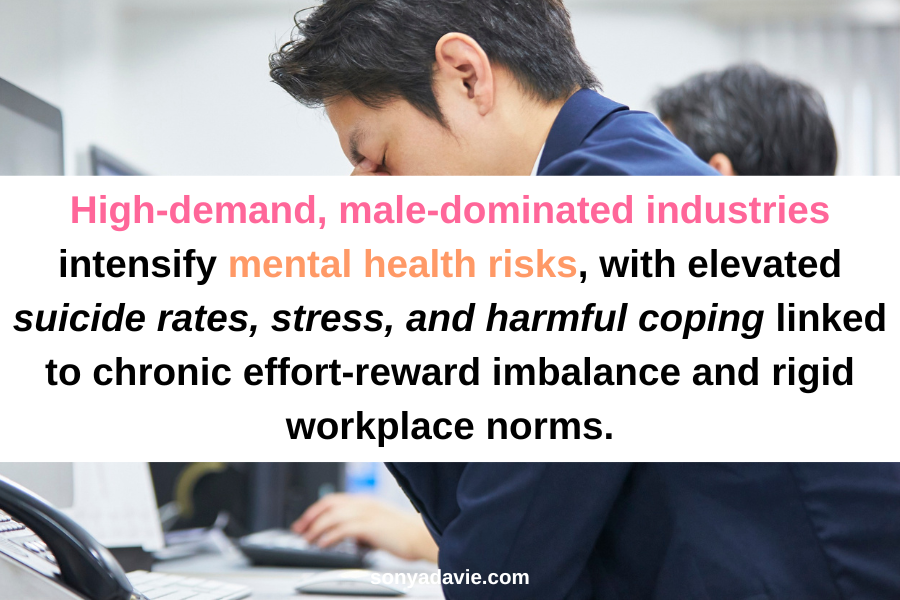
For example, men in construction are 3.7 times more likely to die by suicide than the national average.
In surveys by Mind, over 43% of men reported regularly feeling low or worried, and two-thirds of those engaging in hazardous drinking were men often using alcohol as a primary coping strategy.
A useful way to understand this is through effort-reward imbalance: when men put enormous energy into their work but receive limited recognition, pay, or security in return, the stress isn’t just emotional, it becomes physiologically and psychologically destabilizing. In environments where traditional masculine norms are strongest, this pressure often has nowhere to go.
What This Means Clinically: Looking Beneath the Surface
For clinicians, coaches, and employers working with men, this research invites a deeper level of curiosity.
When a man presents with irritability, substance use, risk-taking, or physical symptoms, it’s worth asking:
What’s happening at work?
How does he experience his role?
Does he feel like he’s failing at something that defines his identity?
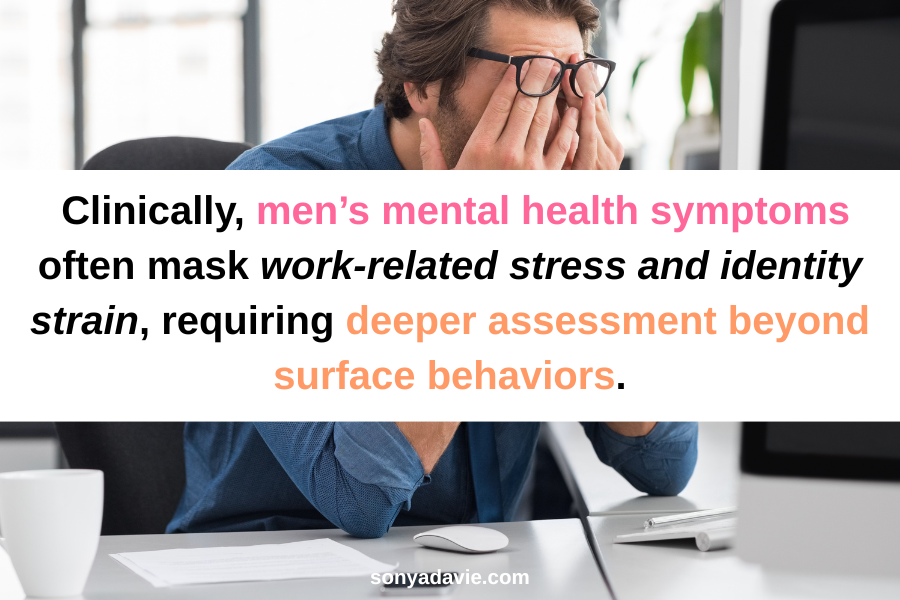
Because often, what looks like anger or addiction on the surface is actually a slow erosion of self-worth happening in silence... frequently at work.
Language also matters.
Research shows men are often more receptive to terms like “mental fitness,” “performance,” or “resilience” than traditional clinical framing. Likewise, peer-based, activity-led support models, where connection happens side-by-side rather than face-to-face in formal settings—are showing strong outcomes.
One UK program reported a 74% improvement in mental health and an 85% boost in wellbeing after six months. (Source)
The effort-reward imbalance model reinforces a key point: workplaces don’t just need to measure performance…
They need to build cultures of recognition. Men need to feel that their value is not solely defined by output.
The Man Who Hasn’t Asked for Help Yet
There is a man reading this, or someone who loves one, who has never told anyone how much work is weighing on him.
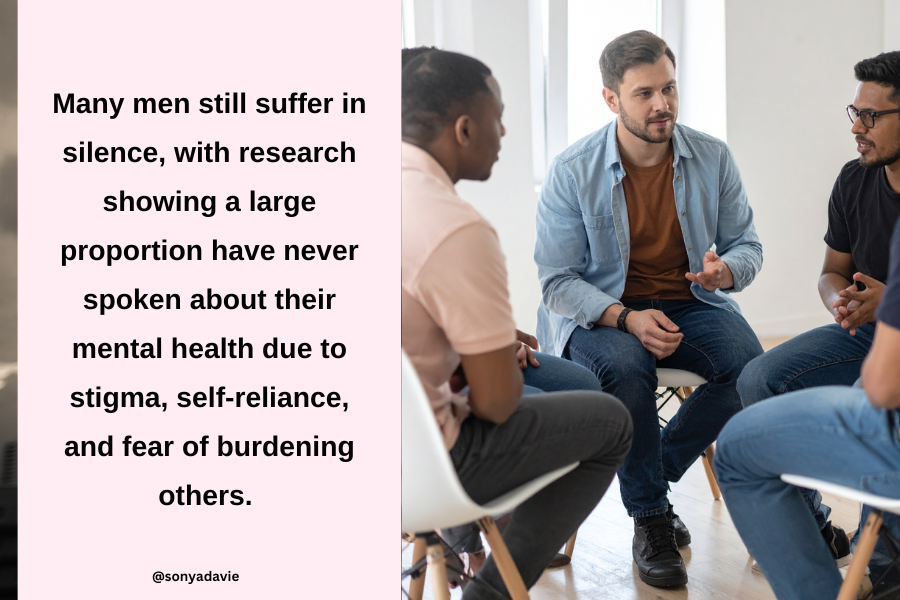
According to a 2024 Priory Group survey, 40% of men have never spoken to anyone about their mental health.
When asked why, 40% said, “I’ve learned to deal with it,” 36% said they didn’t want to be a burden, and 29% said they felt embarrassed.
These aren’t character flaws. They are predictable outcomes of a system that taught men to stay composed, push through, and never show strain.
The 2017 Mind survey opened the door to this conversation. The research since has only made what’s inside the room clearer. Men are not simply struggling because they are weak, they are struggling because the systems around them have rarely made space for anything other than strength.
What You Can Do — Today
If you’re a clinician, coach, HR leader, or someone who cares about the men in your life, here are practical, evidence-informed starting points:
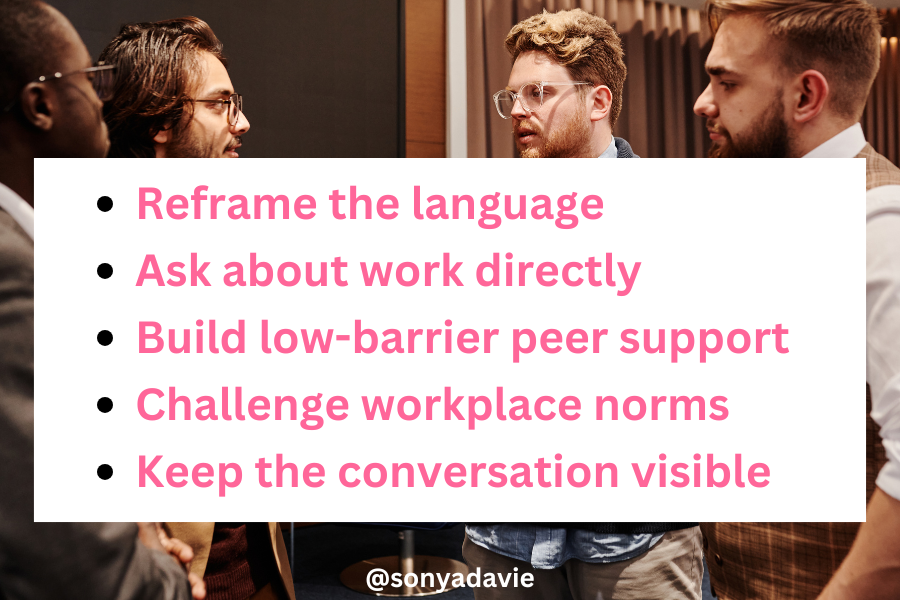
- Reframe the language: Try “mental fitness” or “stress resilience” instead of clinical terms that may feel heavy or stigmatizing.
- Ask about work directly: Make job stress, identity, and financial pressure a routine part of conversations—not an afterthought.
- Build low-barrier peer support: Encourage connection through shared activity rather than formal, sit-down vulnerability.
- Challenge workplace norms: Advocate for psychological safety, realistic expectations, and recognition systems that don’t reinforce emotional suppression.
- Keep the conversation visible: The more this is spoken about in workplaces, online, and in communities, the more permission men have to speak up.
This isn’t about lowering expectations for men.
It’s about finally expanding what support actually looks like.
Related Post: What Men Need to Know About Testosterone, Mental Health, and the Stress That’s Making It Worse





+ show Comments
- Hide Comments
add a comment