


By Sonya Davie, LMHC, INHC, CMHIMP · Founder, Sonya Davie Wellness
You’ve probably said it a hundred times — “they get on my nerves.”
But what if that phrase is more literal than you ever realized? The people who raised you didn’t just shape your beliefs. They shaped your biology.

And if you’ve spent years wondering why you feel anxious around family, why a phone call from your mother can ruin your whole day, or why holidays leave you physically exhausted, this is not weakness.
This is your nervous system telling the truth.
The Phrase We’ve Been Saying Without Knowing What It Meant
Language is rarely accidental. When we say someone “gets on our nerves,” we’re unconsciously naming something the body already knows: that stress doesn’t stay in the mind. It travels. It lands in the shoulders, the gut, the chest, the jaw. It changes the breath. It changes the heartbeat.
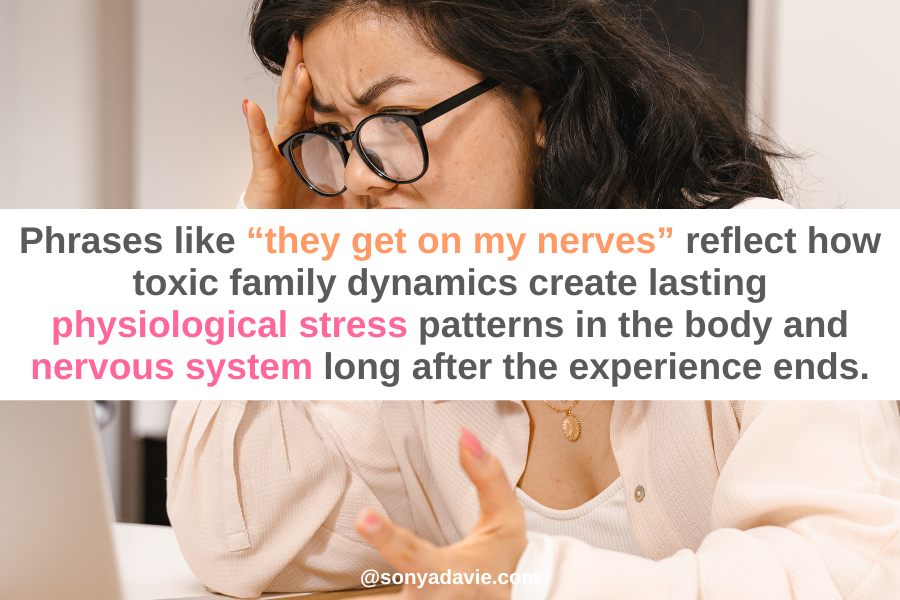
Toxic family dynamics don’t just create bad memories.
They create physiological patterns that the nervous system carries long after the moment has passed. And for many people, those patterns started far earlier than they realize.
What Childhood Emotional Neglect Actually Is
Childhood Emotional Neglect (CEN) is not always what people picture when they hear the word “trauma.”
It’s not necessarily yelling or hitting or obvious cruelty. Often it’s quieter, and in some ways harder to name.
Psychologist Jonice Webb defines CEN as what didn’t happen. The feelings that weren’t acknowledged. The child who cried and was told to stop. The teenager who was anxious but was told they were being dramatic. The adult child who learned early that their emotional experience was inconvenient, excessive, or simply irrelevant. (Source)
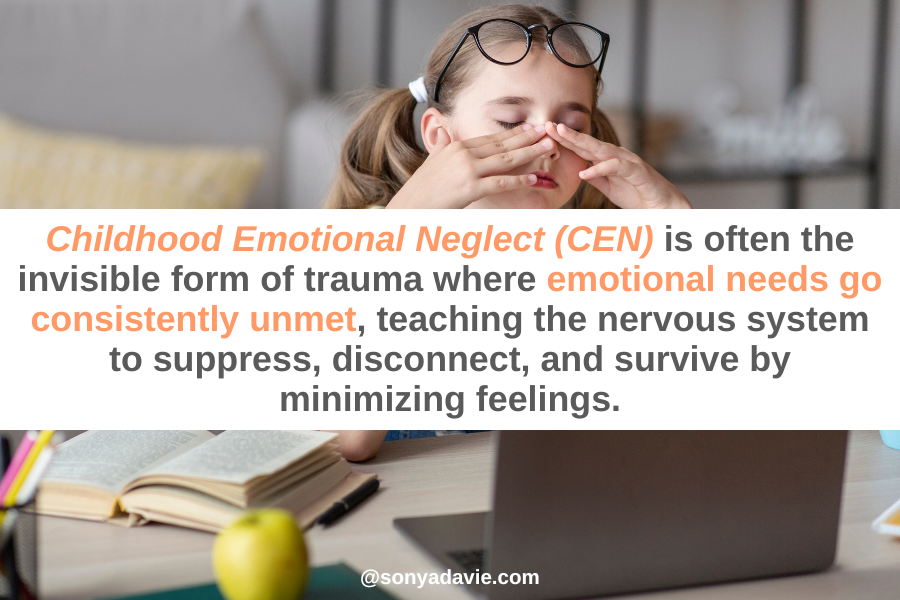
When a child’s emotional needs are consistently unmet, the nervous system adapts.
It learns to suppress. To disconnect. To push feelings down before they cause a problem.
It becomes a survival strategy, one the body will keep running long into adulthood, whether it’s needed or not.
You may not have a dramatic story to tell.
But if you grew up feeling invisible, misunderstood, or like your feelings were “too much” — CEN may be part of your history.
How CEN Rewires the Nervous System
The nervous system is not a static thing. It is shaped by experience, especially repeated experience in early life.
When a child grows up in an emotionally unsafe or emotionally absent environment, the nervous system learns to stay on alert. Or to shut down. Sometimes both, alternating.
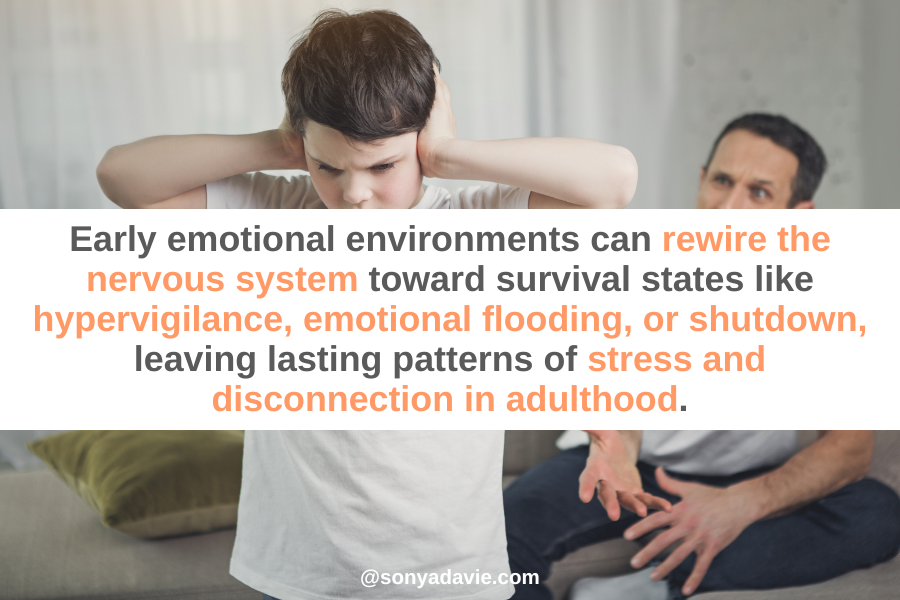
What this looks like in adults:
• Hypervigilance — scanning the room, reading the mood, anticipating the next problem before it arrives
• Emotional flooding — feelings that come on fast, hard, and feel impossible to manage
• Chronic shutdown — numbness, disconnection, going through the motions without really feeling present
• Difficulty identifying what you actually feel in the moment
These are not personality traits. They are nervous system adaptations that outlived their usefulness.
The threat that shaped them may be decades old, but the body is still responding as if it’s happening right now.
Toxic Family Dynamics as an “Ongoing” Nervous System Threat!!!
Here is something that doesn’t get said enough: the nervous system dysregulation doesn’t stop just because childhood ended.
Adult relationships with dysregulating family members keep the threat response active.
The body does not distinguish between a critical parent in 1987 and a critical parent on a Sunday phone call. The nervous system responds to the pattern, the tone of voice, the loaded silence, the familiar tightness in the chest, before the mind has even caught up.
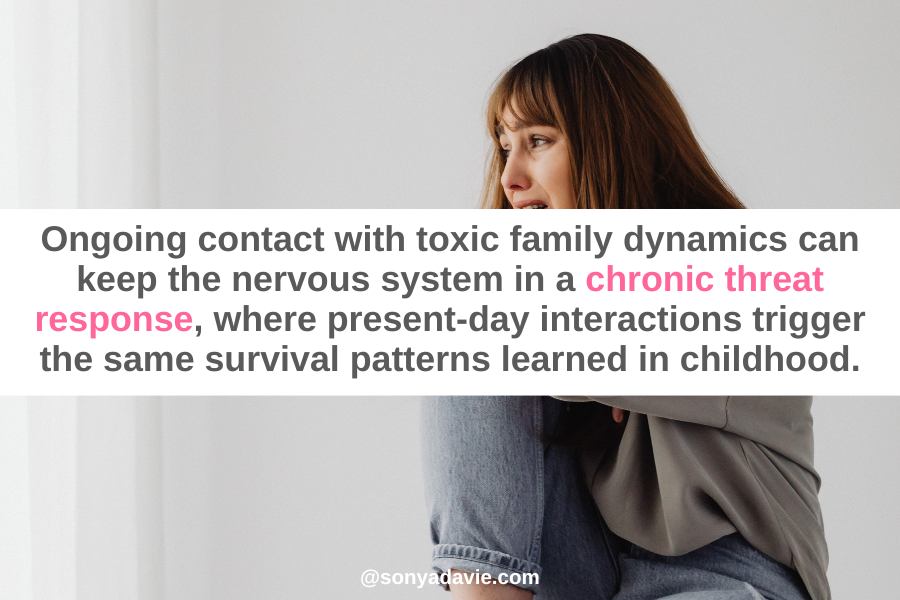
You can be 45 years old, accomplished, clear-headed in every other area of your life, and a single conversation with a parent can send your nervous system right back to childhood.
That is not a failure of maturity. That is biology doing exactly what it was conditioned to do.
And if you are a Highly Sensitive Person (HSP), this dynamic is amplified in ways that deserve to be named directly.
HSPs process sensory and emotional information at a neurological depth that non-HSPs simply do not.
Research by Dr. Elaine Aron identifies this as a trait present in roughly 15–20% of the population — wired into the nervous system, not chosen, and not a disorder. But when an HSP grows up in a family environment where that sensitivity was treated as a problem, too emotional, too dramatic, too much, too sensitive, the wound is compounded. (Learn more about HSP here)
Not only was the emotional environment unsafe. The very trait that made you feel everything most deeply was the thing they criticized most. Over time, many HSPs internalize the message that their sensitivity is a flaw to be managed rather than a capacity to be understood.
The nervous system carries that message in the body as shame, as hypervigilance, as a chronic low hum of not being quite right.
If this resonates, please know this: your sensitivity was never the problem. The environment that couldn’t hold it was.
Why Talk Therapy Alone Often Isn’t Enough
Therapy is valuable. This is not an argument against it.
But it is an honest acknowledgment of its limits when the nervous system is still stuck in the pattern.
The body stores what the mind tries to process.
You can have profound insight about your childhood, understand the dynamics clearly, even forgive and still feel the tightness in your chest when your phone lights up with a family member’s name.
That’s not a failure of your therapeutic work. That’s the nervous system holding what words haven’t yet reached.
Healing the nervous system requires more than understanding.
It requires experience — new, repeated, embodied experience that teaches the body it is safe. That something different is possible.
The Body Definitely Needs a Way Out!
This is where movement becomes more than exercise.
Somatic release (the intentional use of the body to discharge stored stress) is not a wellness trend. It is an evidence-informed way of supporting nervous system regulation.
Rhythm, breath, and movement help create the physiological conditions for the body to begin letting go of what it has been holding.
Dance, in particular, offers something that sitting with emotions alone cannot always access: it helps move the experience through the body. It engages the nervous system directly, without requiring the mind to explain, analyze, or find the right words. It also restores a sense of connection, which itself can be regulating for a system that once learned people were unsafe.
Your body has been holding this. It deserves somewhere to go.
Check my events page for updates on how to join upcoming classes designed to support your nervous system in doing what it has been trying to do for years — RELEASE.
About the Author:
Sonya Davie, LMHC, INHC, CMHIMP is the founder of Sonya Davie Wellness and a licensed mental health counselor with 17 years of experience. Her work integrates functional psychiatry, nervous system healing, and somatic approaches to support whole-person mental wellness.





+ show Comments
- Hide Comments
add a comment