


By Sonya Davie, LMHC, INHC, CMHIMP · Founder, Sonya Davie Wellness
You finally get an appointment with your primary care provider (PCP). You wait weeks, maybe months. Then, once you are in the exam room, the visit can feel rushed: a few questions, a brief screening, a medication recommendation, and a follow-up that may be weeks away.
If you are dealing with anxiety, depression, trauma symptoms, burnout, insomnia, ADHD concerns, or unexplained physical symptoms, that experience can feel frustrating and even discouraging.
You may leave wondering: Did we really get to the root of what’s happening?
Sometimes it can feel as though the healthcare system is asking, “What can we prescribe or refer quickly?” instead of,
“What has been happening in your life, your body, your relationships, your sleep, and your stress levels?”
But this is not simply a story about clinicians who are too busy or don’t care.
It is also a story about a healthcare system that continues to ask primary care clinicians to do more within less time.
When Time Becomes Part of the Care
A recent OECD analysis found that patients who felt their primary care clinician spent enough time with them were nearly 90% more likely to trust the healthcare system. Yet only 47% of people with multiple chronic conditions were in practices that scheduled more than 15 minutes for routine consultations and follow-ups. (Source)
That difference is significant.
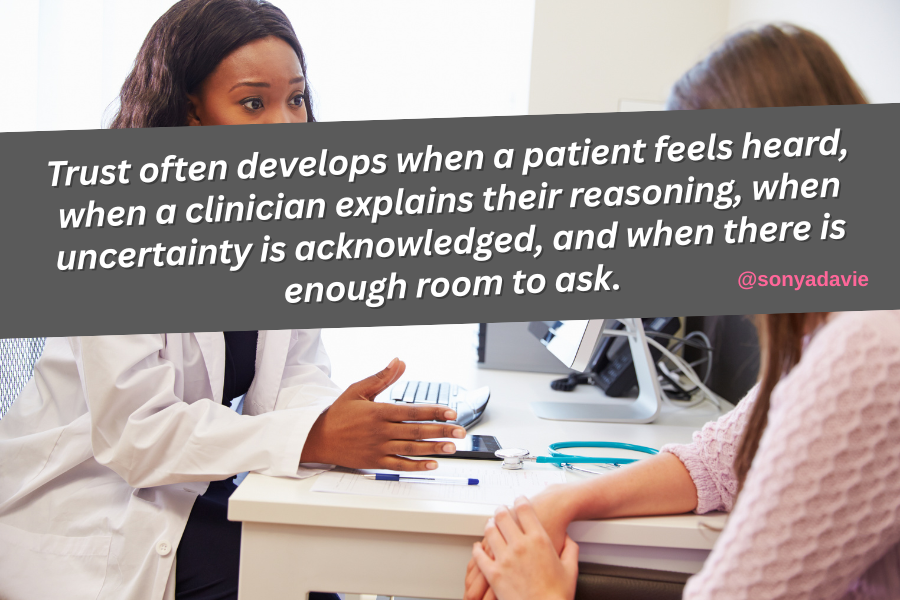
Trust does not come only from credentials, test results, or treatment recommendations.
It can develop through the experience of being listened to, having your concerns taken seriously, understanding why a clinician is recommending something, and having enough time to ask questions.
Consider everything that may need to fit into one primary care visit:
- Medication reviews and refill requests
- Preventive care and screenings
- Blood pressure, weight, sleep, pain, and other physical concerns
- Chronic-condition management
- Lab and imaging results
- Documentation and insurance requirements
- Depression and anxiety screening
- Stress, grief, trauma, caregiving, relationship concerns, or burnout
Fifteen minutes can disappear quickly.
And while not every concern requires a long appointment, some problems simply cannot be understood well without time and context.
Mental health is one of them.
The Impossible Math of Primary Care
Primary care clinicians are facing pressures that are difficult to see from the exam room.
One simulation study estimated that a PCP caring for a representative panel of 2,500 adult patients would need 26.7 hours per day to provide recommended preventive, chronic, and acute care, along with documentation and inbox work. (Source)
Even in a team-based model, the estimate was still 9.3 hours per day.

This helps explain why clinicians may look hurried even when they are deeply committed to their patients.
A primary care physician is not only seeing scheduled patients. They are also reviewing test results, responding to portal messages, completing forms, coordinating referrals, managing refill requests, documenting visits, and addressing urgent concerns that arrive between appointments.
A qualitative study of 25 PCPs across 11 U.S. states found a persistent mismatch between the time allotted for their work and what they were expected to accomplish. (Source)
When time becomes scarce, everyone loses:
- Patients may leave feeling unseen, confused, or unsure about what happens next.
- Clinicians may experience guilt, exhaustion, and burnout.
- Important context, such as trauma exposure, sleep deprivation, substance use, grief, hormonal changes, or social stressors may remain unexplored.
- Referrals, tests, and prescriptions can become the fastest available next step, even when a longer conversation could improve shared decision-making.
This is not an argument against medication, testing, or specialist referral. These interventions can be appropriate, helpful, and sometimes life-saving.
It is an argument for making sure they emerge from adequate assessment, informed consent, appropriate follow-up, and a treatment plan that sees the whole person.
What This Means for Mental Health
Primary care is often the first, and sometimes only, place a person discusses their mental health.
- This is especially important because many people feel more comfortable bringing anxiety, low mood, panic, sleep changes, or emotional exhaustion to a familiar clinician before seeking specialty care.
PCPs carry a major share of behavioral-health treatment. From 2016 to 2018, primary care physicians wrote about half of prescriptions for depression and anxiety, while psychiatrists wrote 37%.
That role is essential.
But mental-health assessment should not be reduced to a checkbox, a score, or a medication decision alone.
Symptoms such as fatigue, irritability, poor concentration, insomnia, panic, low motivation, appetite changes, and brain fog can have many possible contributors. A thoughtful assessment may include discussion of:
- The pattern, timing, severity, and functional impact of symptoms
- Safety concerns, including suicidal thoughts or self-harm
- Sleep, substance use, trauma history, and major life stressors
- Current medications, supplements, medical conditions, and family history
- Therapy, social support, movement, nutrition, and coping resources
- What the patient wants from treatment and concerns they may have about medication
- A clear follow-up plan to assess benefits, side effects, and whether the original understanding still fits
A brief visit does not automatically mean poor care, and a prescription does not automatically mean rushed or inappropriate care.
Medication can be a wise, evidence-based part of treatment.
The concern is what happens when system pressure makes a prescription feel like the only available intervention, or when the patient is not given enough space to participate meaningfully in the decision.
Why Fewer Clinicians May Choose PCP Careers
There is another piece of this conversation that we cannot ignore: who will provide primary care in the future?
Primary care needs more clinicians, yet the career can be difficult to sustain.
The challenge is not a lack of meaning. Many clinicians enter primary care because they value relationships, continuity, prevention, and whole-person care.
The challenge is the environment in which they are asked to do that work.
In the JAMA study, physicians described sacrificing patient education, relationship-building, clear communication, and attention to social circumstances because there was not enough time in the day.
Many sought ways to reduce the number of patients they saw, move into nonclinical roles, work part-time, or transition to lower-volume practice models. (Source)
The workforce pipeline is also a concern. In the AAMC’s 2025 graduating-student survey, 42.7% reported interest in primary care or primary-care subspecialties, meaning most graduating respondents did not report that interest. Meanwhile, projections cited by the National Center for Health Workforce Analysis estimate a shortage of 87,150 full-time-equivalent PCPs by 2037. (Source)
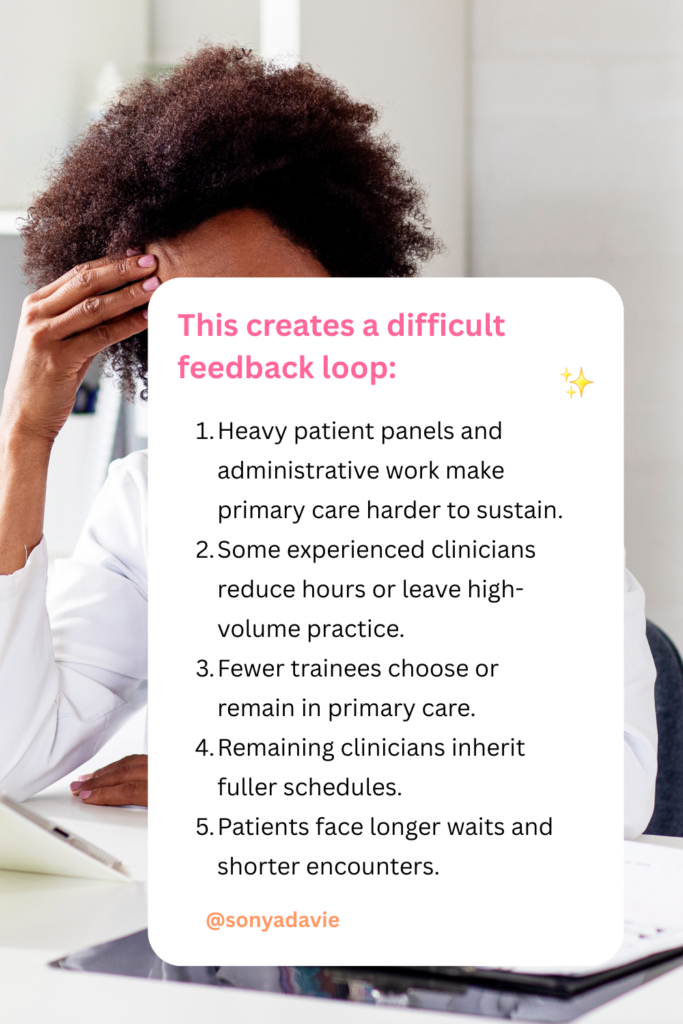
This creates a difficult feedback loop:
- Heavy patient panels and administrative work make primary care harder to sustain.
- Some experienced clinicians reduce hours or leave high-volume practice.
- Fewer trainees choose or remain in primary care.
- Remaining clinicians inherit fuller schedules.
- Patients face longer waits and shorter encounters.
We cannot solve that cycle simply by telling individual doctors to be more resilient or asking patients to be “better prepared” for rushed visits.
The system has to make relationship-based care possible. (The system itself has to change.)
Building Care That Has Time and Trust
The good news is that better care does not necessarily depend on making every appointment dramatically longer. It also depends on redesigning how care is delivered and supported.
The bedside-care framework highlighted in the Medscape report points toward several valuable principles:
Observe the patient carefully, use focused and hypothesis-driven examination, intentionally practice communication and clinical skills, use technology to reinforce, not replace human judgment, offer thoughtful feedback, and recognize that patient interaction itself can be therapeutic.
In primary care, that can look like:
- Scheduling longer or dedicated visits for complex mental-health concerns.
- Building integrated teams that include therapists, social workers, psychiatric consultants, nurses, pharmacists, care managers, and community health workers.
- Protecting clinician time for messages, documentation, results, and care coordination rather than pushing those tasks into unpaid after-hours work.
- Using screening tools as conversation starters rather than substitutes for clinical listening.
- Creating reliable follow-up after a new psychiatric medication is started or changed.
- Developing referral pathways that do not leave patients waiting months without guidance.
- Designing technology and AI tools to reduce clerical burden — not to replace observation, clinical reasoning, or human connection.
Team-based care is particularly promising because it allows patients to receive the right kind of support from the right professional, rather than expecting one PCP to carry every task alone.
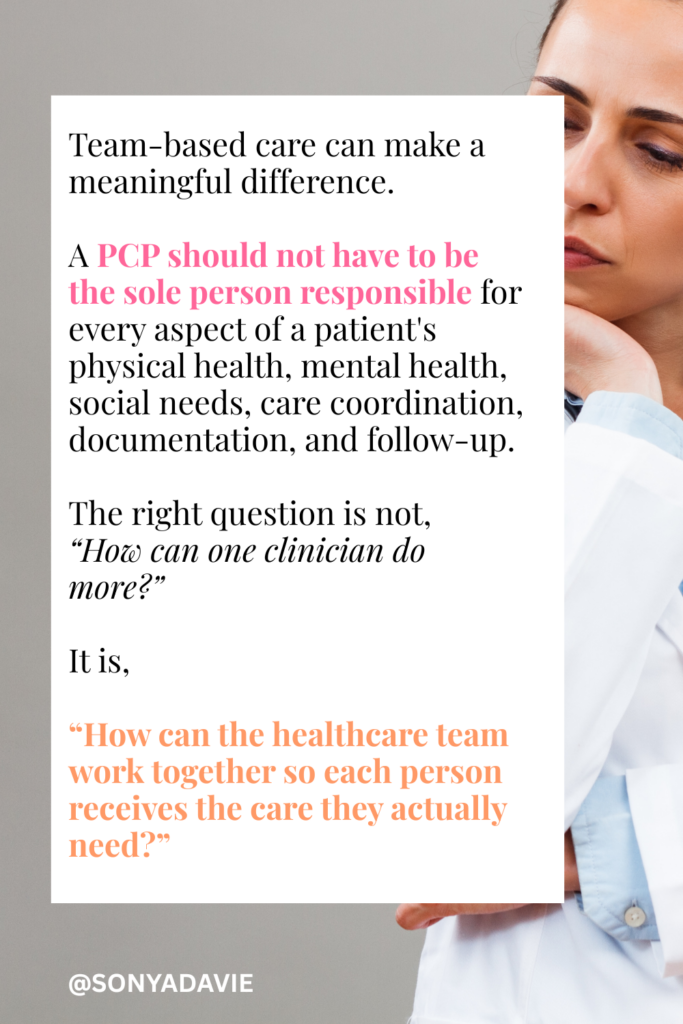
Research suggests that team-based models can shift substantial preventive and chronic-care work across a broader clinical team, although they require staffing and payment systems that make that care financially sustainable.
A Message for Patients…
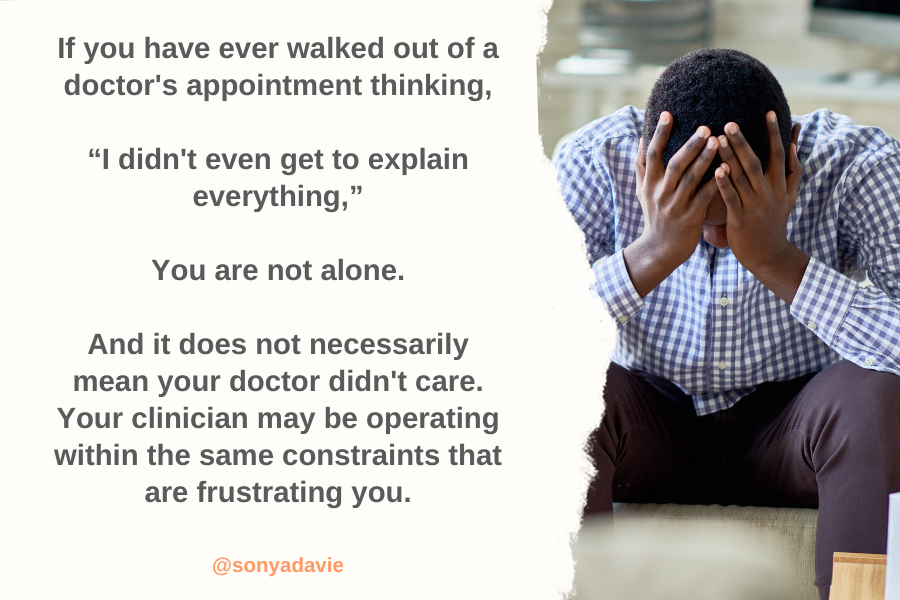
If you have left a PCP appointment feeling rushed, dismissed, or confused, that feeling is valid.
It does not mean you failed to explain yourself well, and it does not necessarily mean your clinician did not care. Often, both patient and clinician are being squeezed by the same system.
When possible, consider booking a visit specifically for mental health rather than trying to add it to an already-full appointment.
Bring a concise list of symptoms, questions, medications and supplements, relevant history, and your goals for care.
You can also ask:
- “What diagnosis are you considering, and what else are you ruling out?”
- “What are the benefits, risks, and alternatives to this medication?”
- “When should I expect a change, and what side effects should prompt me to call?”
- “When will we follow up?”
- “Can you connect me with therapy, psychiatry, or behavioral-health support if I need more time than this visit allows?”
You deserve care that treats you as more than a symptom list or prescription opportunity.
And clinicians deserve a healthcare system that gives them enough time, support, and team resources to practice the kind of medicine that brought many of them to primary care in the first place.
Time and trust should not be competing goals. In a humane healthcare system, time is one of the ways trust is made.





+ show Comments
- Hide Comments
add a comment