


By Sonya Davie, LMHC, INHC, CMHIMP · Founder, Sonya Davie Wellness
Last month’s Power Women Dinner had the same energy it always does.
Around the table sat a group of high-level, high-achieving women — the kind who run companies, lead teams, hold families together, and still show up polished and present for a monthly gathering built for real conversation.
It started the way it always does, with someone sharing what was actually going on in her life.
This time, it was an attorney at the table who opened up first.
She shared that she’s come to realize she’s refueled by time alone, that after a full day, a demanding case, or any stretch of heavy social interaction, solitude is what restores her. Then she said something that surprised the room: she’d actually gone and researched introversion on her own, because she kept noticing how drained she felt after social settings that everyone else seemed to breeze through.
What she found in that research helped her put language to something she’d felt for years but never quite named
— she was, without question, an introvert.
One by one, the other women began sharing the same sentiment, completely unprompted. No one was fishing for agreement, no one expected the room to land on the same answer. But it did. Woman after woman described that same pull toward solitude: the need to turn off the phone, step back from the noise, and simply be alone to reset and refuel.
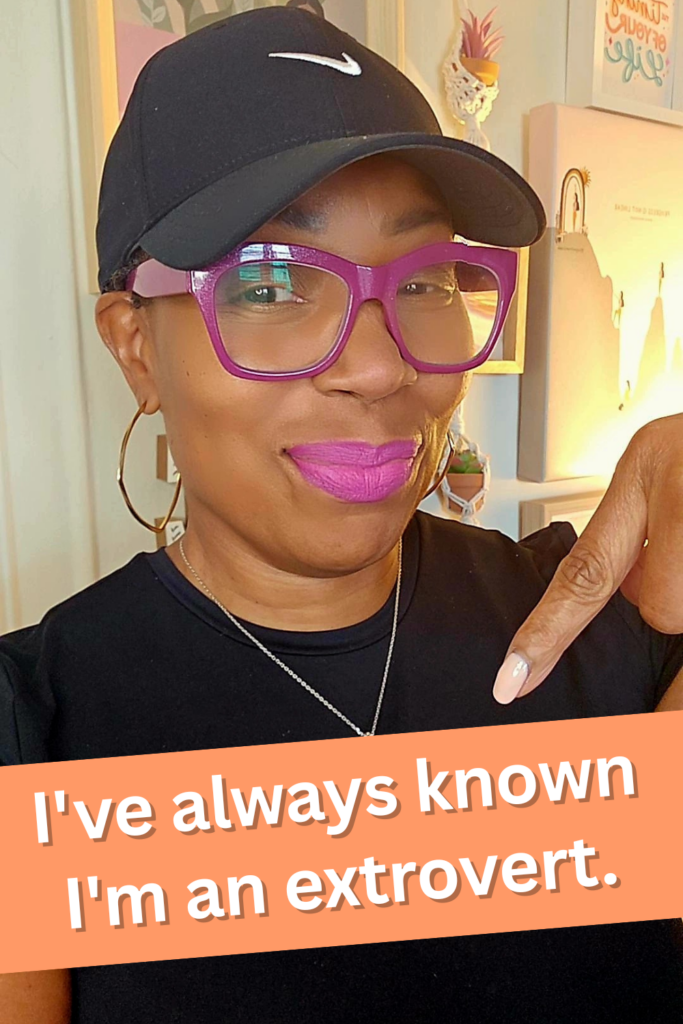
I’ve always known I’m an extrovert and that I’m energized by being around people.
As the only extrovert in the group that night, it turned into an interesting conversation. Conversation, energy, a full room — that’s what lights me up and fuels me.
We ended up having an open, honest conversation about how differently our bodies and nervous systems respond to people and social settings. For the introverts at that table, time alone isn’t a luxury — it’s how they refuel. For me, and for extroverts like me, it’s people and connection that do the same job.
What struck me most wasn’t just the difference:
It was how surprised even the attorney was to discover this about herself, after years of assuming her exhaustion after social settings meant something was wrong with her, rather than simply understanding how she’s wired.
So I said what I’ve come to believe deeply in my work as a therapist:
You have to honor your trait, or your body will eventually make you.
This isn’t about picking a lane and hiding there. It’s about understanding your own nervous system well enough to know what actually fuels you, and building a life, a calendar, and a set of boundaries around that truth, instead of around what you assume you’re supposed to need.
Neither is a personality quirk. Both are real physiology.
So What’s Actually Happening? Introversion, Extroversion & the Nervous System
The introvert-extrovert spectrum is one of the most studied dimensions of personality psychology, and decades of research suggest that…
These differences begin in the brain.
#1 It starts with arousal.
Decades ago, psychologist Hans Eysenck proposed a biologically based model of personality: introverts and extroverts differ in their baseline level of cortical arousal, essentially, how alert and stimulated the brain already is at rest. (Source)

Introverts tend to run with naturally higher baseline arousal and may process more information per second even in calm conditions.
Put an introvert into a high-stimulation environment — a loud restaurant, a packed conference room, back-to-back client meetings on a business trip, and that already-elevated system can tip into overload quickly, causing a kind of mental shutdown that pushes them to withdraw and recover.
Extroverts, running with comparatively lower baseline arousal, need more external stimulation to feel alert and engaged. This same model has been supported repeatedly across decades of research on the reticular activating system (RAS), the brain structure responsible for regulating arousal — studies consistently find higher basal RAS activity in introverts than in extroverts.
#2 Then there’s dopamine.
Extraversion has been consistently linked to greater sensitivity in the brain’s reward pathways, particularly the dopamine system.
Research out of Cornell University, published in Frontiers in Human Neuroscience, found that extraversion is tied to the activity of the mesocorticolimbic dopamine pathway — the brain’s core incentive-reward circuit. (Source)
In a follow-up lab study, extroverts showed strong “associative conditioning”: their brains linked a neutral environment with a past reward experience and responded with increased dopamine activation days later, while introverts showed little to no evidence of that same conditioning. In plain terms —
Extroverts’ brains are wired to seek out and relive rewarding social experiences, which is part of why a room full of people, energy, and conversation reads as fuel rather than static.
Introverts, by contrast, tend to be more sensitive to dopamine, meaning the same level of stimulation that energizes an extrovert can tip into overwhelming for them.
Some researchers point to acetylcholine, a calmer, subtler neurochemical linked to focus, reflection, and deep thinking, as the introvert’s equivalent reward system: quiet, low-key, internally-focused activity feels good to them in much the same way high-stimulation socializing feels good to an extrovert.
#3 Brain structure backs this up, too.
Functional imaging studies show introverts tend to exhibit greater activity in the prefrontal cortex — the region tied to planning, decision-making, and abstract thought — while extroverts show stronger activity in regions linked to sensory processing and reward anticipation.
A study published in the Journal of Neuroscience went further, finding that introverts actually had thicker, larger gray matter volume in the prefrontal cortex compared to extroverts, whose gray matter in that same region was comparatively thinner. (Source)
Taken together, this is three independent, converging lines of research — arousal regulation, dopaminergic reward sensitivity, and brain structure itself — all pointing to the same conclusion:
Introversion and extroversion are not preferences or moods. They are neurobiological dispositions.
The pull an introvert feels toward solitude after a demanding trip, and the pull an extrovert feels toward more people afterward, are both the nervous system doing exactly what it’s built to do.
Why This Matters Clinically
I bring a functional psychiatry lens to this conversation because I see the fallout in my practice constantly: high-achieving women, often introverts, who have spent years pushing past their own nervous system’s signals because rest and withdrawal get coded as unproductive or antisocial. Chronically overriding your baseline wiring isn’t neutral!
It shows up as dysregulated cortisol patterns, disrupted sleep, irritability, and the kind of bone-deep exhaustion that a weekend off doesn’t actually fix.
On the flip side, extroverts who isolate too much through remote work, caregiving demands, or simply believing solitude is the “healthier” choice… can experience their own version of depletion: low mood, restlessness, and a creeping sense of disconnection.
The goal isn’t to force yourself into the opposite pattern.
It’s to get honest about which one you actually are, and build your calendar, your boundaries, and your recovery practices around that truth — not around what you think a “successful” schedule is supposed to look like.
A Few Reflection Questions…
Before deciding whether you’re more introverted or extroverted, take a moment to check in with yourself. These questions aren’t about putting yourself into a box… they’re an invitation to notice what genuinely energizes you, what drains you, and how your nervous system naturally responds.
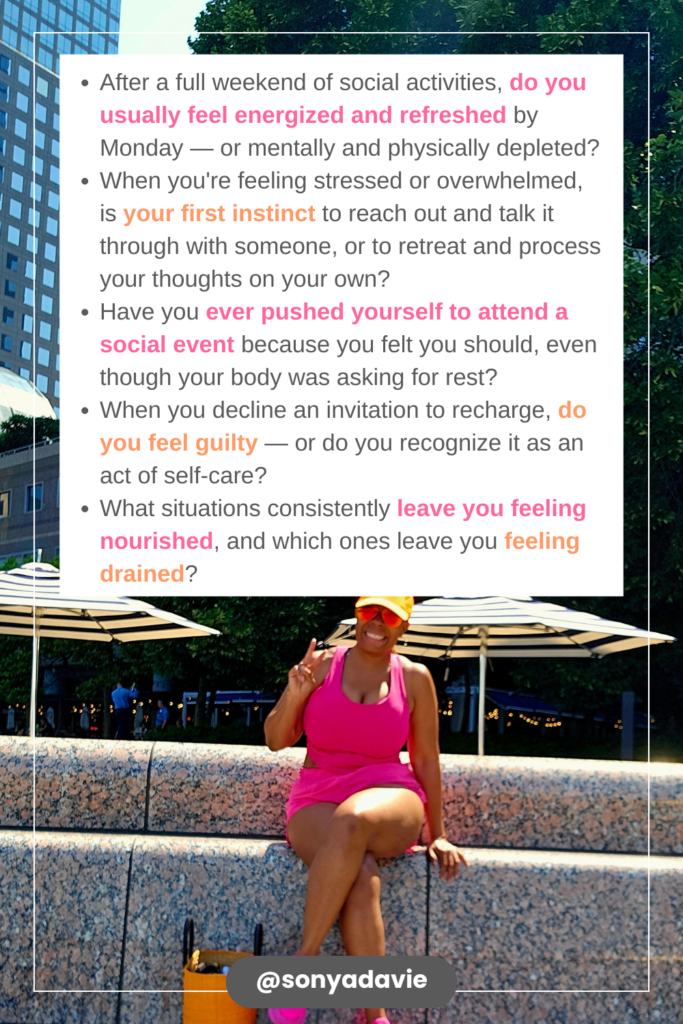
- After a full weekend of social activities, do you usually feel energized and refreshed by Monday — or mentally and physically depleted?
- When you’re feeling stressed or overwhelmed, is your first instinct to reach out and talk it through with someone, or to retreat and process your thoughts on your own?
- Have you ever pushed yourself to attend a social event because you felt you should, even though your body was asking for rest?
- When you decline an invitation to recharge, do you feel guilty — or do you recognize it as an act of self-care?
- What situations consistently leave you feeling nourished, and which ones leave you feeling drained?
There are no right or wrong answers. The goal isn’t to label yourself…
It’s to better understand how your nervous system naturally responds so you can honor what helps you thrive.
If this resonated with you, I’d love to hear: are you an introvert, an extrovert, or somewhere in between — and how well is your current lifestyle actually honoring that?
Research & Further Reading
- Bullock, W. A., & Gilliland, K. (1993). Eysenck’s arousal theory of introversion-extraversion: A converging measures investigation. Journal of Personality and Social Psychology, 64(1), 113–123.
- Cain, S. (2012). Quiet: The Power of Introverts in a World That Can’t Stop Talking. Crown Publishers.
- Depue, R. A., & Fu, Y. (2013). On the nature of extraversion: Variation in conditioned contextual activation of dopamine-facilitated affective, cognitive, and motor processes. Frontiers in Human Neuroscience, 7, 288.
- Forsman, L. J., de Manzano, Ö., Karabanov, A., Madison, G., & Ullén, F. (2012). Differences in regional brain volume related to the extraversion–introversion dimension: A voxel based morphometry study. Neuroscience Research, 72(1), 59–67.
- DeYoung, C. G., Hirsh, J. B., Shane, M. S., Papademetris, X., Rajeevan, N., & Gray, J. R. (2010). Testing predictions from personality neuroscience: Brain structure and the Big Five. Psychological Science, 21(6), 820–828.




+ show Comments
- Hide Comments
add a comment